
Christmas gifts for kids: choose by age and type
9/15/2026
Christmas gifts for kids sorted by age and type: to play with, to keep and for bedtime. Plus the mistakes that leave a present forgotten in the corner.
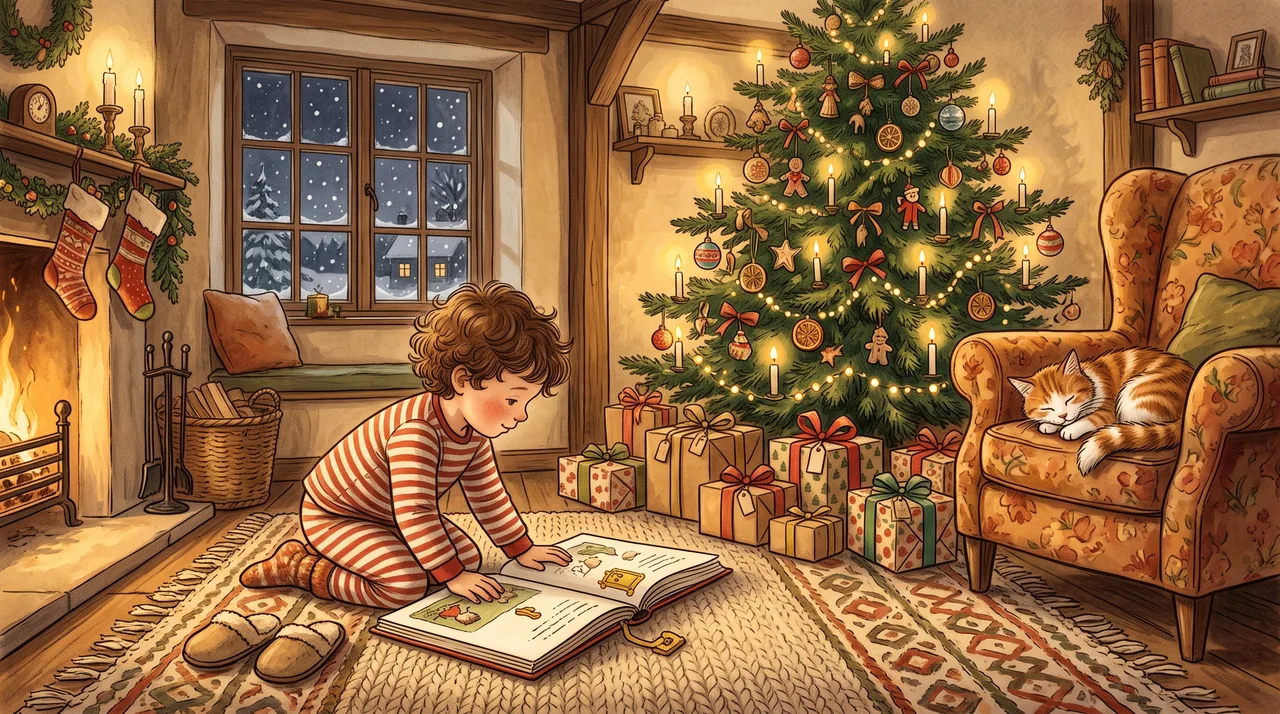
Christmas gifts for kids fall neatly into three baskets: to play with, to keep and for bedtime. One from each is plenty under the tree — any more and by the fifth parcel your child is just waiting to see what comes next, and ends up playing with the wrapping paper. Choose by what your child can do right now and what actually gets used in your home, not by the age printed on the box.
Where to go next, by age and type of gift
Think of this article as a signpost. Each chapter has its own article full of specific ideas — this is just the map, so you know which way to head.
Three gift baskets: to play with, to keep, for bedtime
Most Christmas lists lump together things that have completely different lifespans in a family. Sort your gifts into three baskets and you'll instantly see what you have five of under the tree — and what's missing altogether.
| Basket | What goes in it | When it gets opened | How long it lasts |
|---|---|---|---|
| To play with | Building sets, dressing-up clothes, a scooter, a board game, arts and crafts | Straight away by the tree, played with that very day | Weeks to months, then it goes into rotation or out the door |
| To keep | A book with your child's name, a photo book, a handprint, jewellery with a date, a letter to the future | Quietly, once the first wave of parcels has settled | Years — it comes out when your child can read, and again when they're grown up |
| For bedtime | A read-aloud book, an audiobook, a reading lamp, a cuddly toy for bed | That same evening at bedtime | Every day, for as long as the bedtime routine lasts |
By age: from toddler to schoolchild
The age range on the packaging is the manufacturer's rough guess. A more useful question is: what is your child practising right now, and what do they love doing over and over?
- 1–3 years: moving, banging, copyingA toddler doesn't need surprises, they need repetition. Two things that almost always land at this age: - A shape sorter or stacking cups — they can tip them out and fill them up fifty times in an afternoon, and that repetition is exactly what they crave. A toy with a single right answer that is then “finished” lasts one afternoon. - Something to copy from around the house: a broom, a bucket, a cloth, a toy phone. Toddlers copy what they see you doing — which is why a dustpan and brush will grab them more than a toy that makes ten noises on its own. Leave anything with small parts, magnets or button batteries for later: at this age children explore the world with their mouths. Books should be sturdy board books that can survive being climbed on. This stage ends when your child stops just moving things around and starts playing “pretend” with them — a cup becomes a mug, a block becomes a car.
- 3–6 years: roles, stories and “that's me”Preschoolers play at being someone. They're drawn to anything you can build a story around — but there's a big difference between one costume and another: - A costume as fabric, not a movie outfit. A cape, a hat, an apron and a scrap of scarf last for years, because today they're a dragon and tomorrow a shopkeeper. A specific film character stops working the moment your child moves on to another one. - A cooperative board game with no reading — one where players team up against the game, a round takes under five minutes and the rules are in pictures. Preschoolers can't yet lose without tears, so a game everyone wins together will be played again and again; a race game where players get knocked out ends after the second try. This is also the age when children first recognise their own name in print and are thrilled by it — which is why books starring the child themselves work so well here. This stage ends when your child no longer needs a grown-up to narrate the game and starts inventing and policing the rules on their own.
- 6–9 years: a first real skillSchoolchildren want something they can get better at, with a result to show off. Two safe bets: - A science kit they can manage alone — you'll spot one because everything is in the box, refills included, the instructions are in pictures and it doesn't say “adult supervision required” on every step. Kits that need boiling water, mixing chemicals or hunting round the kitchen get opened once with a parent and never again. - Something where progress shows: a skipping rope, a bouncy ball, a simple musical instrument, a building set with instructions where you can build a model and take it apart again. Children this age love being better at something today than they were last week. With books, this age splits on reading stamina: one child will read a chapter book alone, another still needs someone to read it to them. Choose by what you actually see at home, not by what their classmates are reading. This stage ends when your child starts judging gifts through their friends' eyes — the first “that's for babies” is your signal.
- 9–12 years: their own space and their own crowdOlder children will reject anything that looks “babyish”. Two things work: - Things that belong only to them — and that their friends have too: headphones, their own backpack, an alarm clock, a lamp and a shelf above the bed, a sign for the bedroom door, a box with a key. It's not about the price, it's about not having to share it with a sibling. - A gift to enjoy with friends: a ball, a frisbee, a pocket card game, a forty-five-minute board game, kit for a sleepover. At this age the most precious gift is an excuse to get together. A keepsake won't win you points on Christmas morning, but it's exactly the thing they'll take with them when they leave home in ten years, long after the headphones have been thrown away. This stage ends when your child starts asking for money instead of things — at that point, rather than guessing, just ask.
To keep and for bedtime: the two forgotten baskets
The play basket fills itself — grandparents, godparents and toy catalogues see to that. The other two need someone to choose for them on purpose, or they stay empty.
A keepsake is a gift whose value grows over time, not on Christmas morning. You'll recognise one by three things: it captures a particular child in a particular year, you can't buy the same one twice, and once unwrapped it isn't played with — it's leafed through, shown to Grandma, and put on a shelf, in a drawer or in the box with important papers. Think a handprint and footprint, a photo book of the past year, jewellery with a date, a letter to the future, or a book in which your child is the hero — ours is made from a single uploaded photo, so the hero looks like that very child, and their name runs naturally through the story. Straight after unwrapping, do two things: write the date and a few words of your own inside (without them, even a beautiful thing becomes anonymous within two years), and put the gift somewhere it will survive the next bedroom tidy-up — not among the toys. After that it comes out on its own: when your child can read their own name, when they ask what they were like as a baby, and one last time when they move out. You'll find ready-to-copy wording in our article on book dedications.
Bedtime is the basket used most often of the three, yet it turns up least under the tree. Most families have a bedtime routine every single day; a gift that fits into it gets opened a hundred times a year. A read-aloud book, a reading lamp, a cuddly toy to fall asleep with, or an audio version of the story for evenings when nobody has a voice left for reading — with us, you can add an audiobook to a finished book for $3.99. What works with a routine like this, and what breaks it, is covered in bedtime stories.
Five mistakes that leave a present in the corner by New Year
- Too many toys at onceTen parcels don't mean ten times the joy. After the third, a child stops unwrapping with excitement and starts ticking things off — and a toy that would have lasted a month on its own gets lost among the others before it's ever properly played with. If there are a lot of parcels, hide some away and bring them out over the winter. Come spring, you'll have a second Christmas for free.
- A gift that never gets usedThe classic: a big set that needs a grown-up, a clear table and two quiet hours. In most homes that happens three times a year. Before you buy, answer honestly when exactly it will be played with — and if the answer is “at the weekend, when we have time”, pick something your child can manage alone instead.
- The age on the box instead of the skillA “suitable from 3 years” label is above all a safety note about small parts, not a promise your child will enjoy it. Two children of the same age have different attention spans and different interests. Look at what your child is practising right now, not at the number on the packaging.
- A gift the parent wantedA wooden play kitchen that matches the living room, a musical instrument, an educational set. None of these is a mistake if your child wants it — the mistake is using a gift to fulfil a parent's wish that the child had different interests. You'll know it's happening when you find yourself planning in advance how to get them into it.
- Nobody knows what everyone else is buyingThree building sets and no book happen when relatives don't coordinate. Post a simple list by basket in the family group chat: play is covered, what's missing is something to keep and something for bedtime. It isn't bad manners, it's how you prevent building set number four.
How to choose a gift in ten minutes
When you're staring at an empty list and Christmas is just around the corner, work through this in order.
- 1Write down what your child did last weekNot what they like in general, but what they actually did: built, drew, rode a scooter, listened to a story. That list is your brief.
- 2Sort what you already have into three basketsIt almost always turns out that the play basket is overflowing while the other two are gaping empty. That tells you which way to go.
- 3Pick one main gift and one small oneThe main one from the basket that's missing, the small one from what your child did last week. Two things to unwrap are more than enough.
- 4Check two things: safety and spaceFor under-threes: small parts, magnets and button batteries. For big items: where it will actually go at home — a gift that's in the way is the first to vanish into the loft.
- 5Write the dedication before you wrap the giftOnce it's wrapped, nobody ever does. And with a keepsake, those words are half its value.
What to write on the gift tag (ready-to-copy messages)
These aren't dedications meant for years to come, but short Christmas cards for this year's parcel: what your child is up to right now, who chose the gift and what year it was. Rewrite them in your own words — each one comes with a note on which phrase carries the weight, so you can write your own.
Sources
- Safety Gate — the EU rapid alert system for dangerous products — A database of products withdrawn from the market, toys included; you can use it to check whether a particular type of toy appears among the alerts.
- HealthyChildren.org (American Academy of Pediatrics) — A parenting site with advice on toy safety and on what makes sense for children at each stage of development.