
Toys matched to what your child can already do: skill instead of age
8/29/2026
Push carts, shape sorters, blocks and books sorted by the skill your one-year-old is practicing right now — and how ten minutes on the carpet tells you which one it is.
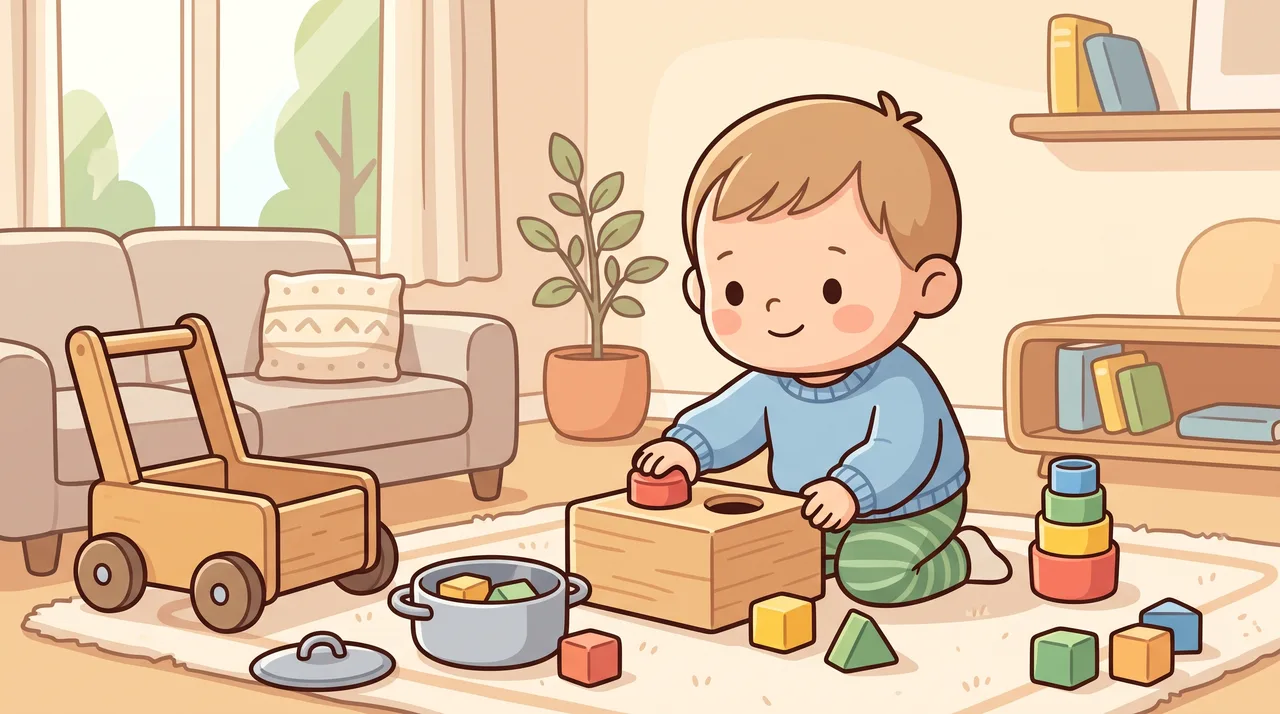
Don't buy by the age on the box, buy for the one skill your child is drilling right now: whatever they do over and over is what they're practicing. Pulling up to stand and cruising along the couch → a push cart. Picking up crumbs with thumb and forefinger → a shape sorter or a knob puzzle. Dumping a basket out and filling it up again → blocks, containers and lids. Pointing and repeating syllables → a naming book. Ten minutes of watching tells you the skill, and a toy bought for exactly that skill has a chance of staying in play for weeks, not for one afternoon.
Why the age on the box doesn't match what your child can do
The number on the packaging isn't a developmental recommendation, it's a safety warning. The US small-parts rule (16 CFR 1501) bans small parts in toys intended for children under three and defines them by a cylinder that mimics the throat of a child under three years old — anything that fits inside it whole is a small part. In Europe, standard EN 71 does the same with the crossed-out “0–3” symbol. So a “3+” label says “contains something a child could choke on”, not “your child is ready for this”.
And age on its own has exactly the opposite problem. The WHO measured when children reach six gross motor milestones, and the window for walking alone runs from roughly 8.2 to 17.6 months — two healthy children born on the same day can be nine months apart in walking. Buying by date of birth means one child gets a toy they can't grip yet and the other gets one they have already outgrown.
That's why the only usable guide is what your child does this week. Handle safety separately and strictly — that's what the four safety filters for children under three are for.
Ten minutes on the carpet: how to spot what your child is practicing
You don't need a test or a milestone chart. You need to sit down, suggest nothing and watch what your child picks out on their own.
- 1Sit off to the side and offer nothingThe moment you hand over a toy, you're measuring your idea, not their interest. Leave out on the carpet what they normally have available and just watch for ten minutes.
- 2Look for repetition, not delightA skill being practiced looks boring: the same thing twenty times in a row. A child who takes the lid out of a pot and puts it back fifteen times isn't suffering — they're doing their job.
- 3Write down the verb, not the toyNot “plays with a pot”, but “puts in and takes out”. The verb is what you can buy again in another material; that particular pot is only today's vehicle for it.
- 4Notice what they grip withThe whole palm over the object, or thumb against forefinger? The pincer grip opens up shape sorters, threading and finger food. Without it, a shape sorter is just a box to throw.
- 5Check what they do with supportWhatever they manage while you hold their hands or they lean on the sofa, they'll do alone in a few weeks. That's where a gift meant to last hits home — one step ahead, not a year ahead.
The skill, the toy and what not to be fooled by
The table is the whole article in shorthand: on the left what you'll see on the carpet, on the right the most common buying mistake.
| What your child is doing | What to give them for it | Where the purchase misses |
|---|---|---|
| Pulls up to stand, cruises along the furniture | A heavy push cart with a brake or a wide wheelbase | A sit-in baby walker — pediatricians advise against it and it doesn't train walking |
| Picks up crumbs with thumb and forefinger | A shape sorter with knobs, knob puzzles, large beads on a peg | Puzzles without knobs: the child can't lift the pieces and interest ends |
| Dumps containers out and fills them up again | Nesting blocks, bowls, lids, empty boxes | A construction set with instructions — the instructions are for the parent, not the child |
| Knocks down the towers you build | Light soft or cardboard blocks that don't hurt | A wooden set that can land in someone's teeth |
| Looks for things hidden under a blanket | Boxes with lids, pots, simple peekaboo games | An electronic toy with a button — it replaces the search with a sound |
| Points and repeats syllables | A board book with large objects, a naming book | A talking toy that narrates instead of you |
| Scribbles on paper with a crayon, turns the wrist | Chunky crayons, big sheets of paper, stamps | Coloring books with outlines — staying inside the lines is a long way off |
Pulling up to stand and cruising the furniture: a push cart
“Walks holding on to furniture” is a milestone the US CDC lists at one year, alongside pulling up to stand. In the phase between cruising along the couch and the first independent steps, only one kind of toy makes sense: something heavy to lean into that moves forward more slowly than the child walks.
Weight and wheelbase decide it, not the design. An empty plastic cart shoots off ahead and leaves the child lying on the floor — which is why carts get loaded with books or bottles of water until balance catches up. A good cart has wide wheels set far apart, a handle roughly at the chest height of a standing child, and a brake or at least rubber tires that offer resistance. A sturdy fruit crate or a small chair turned backrest-forward does the same job.
A sit-in baby walker, the kind a child is seated inside, is a different thing and only gets confused with it because of the similar name: the CDC explicitly advises against it. It isn't only about falls down the stairs — a child inside one can't see their own feet and pushes off with their toes, so they aren't practicing what they need.
And when does the cart go down to the basement? Once the child walks alone, they usually stop pushing and start pulling and carrying. A cart you can load cargo into survives that transition.
Picking up crumbs with thumb and forefinger: shape sorters and knob puzzles
“Picks things up between thumb and forefinger, like small bits of food” — that's how the CDC describes the pincer grip at one year. It's the moment a whole class of toys opens up, and you'll recognize it because your child starts fishing crumbs off the floor with suspicious precision.
The first step is knob puzzles with a wooden peg: one shape, one recess, and a knob sized for exactly two fingers. Then come shape sorters — and the usual mistake here is to buy a cube with ten holes straight away. Given ten holes to choose from, the child misses, and whatever misses gets thrown. Start with a box with a single hole (a circle is the easiest) and add shapes.
Third in the same family is threading onto a fixed peg — rings on a post are an order of magnitude easier than beads on a string, where both hands and a floppy material have to be controlled.
Stick to the “one variable” rule: when you change the size, keep the shape; when you change the shape, keep the size. And everything bought for this passes the small-parts test — things for the pincer grip tend to be exactly the size that disappears into a mouth.
Dumping, filling and hunting for the hidden: blocks, containers and lids
Among the CDC's one-year milestones are “puts something in a container, like a block in a cup” and “looks for things they see you hide, like a toy under a blanket”. The second one is object permanence — the child has just grasped that a thing exists even when hidden, and has to test it about two hundred times.
Play built on that can be equipped almost for free: a pot with a lid, a cookie tin, plastic bowls, a set of lids, empty boxes. The store-bought version is nesting cups — one of the few toys with three lives in a row (they nest inside each other, they stack into a tower, they pour in the bath).
With blocks, at this age you aren't buying stacking, you're buying knocking down. The adult builds the tower, the child takes it down, and that's fine — the CDC lists putting two objects on top of each other only at fifteen months. So pick light blocks: soft, fabric or cardboard. A wooden set is beautiful, but at this stage it flies through the air.
What kills this game is a toy with a button that answers a dropped block with a tune. The child then learns to press a button instead of exploring what happens.
Pointing and repeating syllables: a book instead of a talking toy
Pointing is the most important “toy” without a toy at this age — the CDC advises parents to answer it with words (“Do you want the cup? Here's the cup.”). The material that fits isn't a story with a plot, but a page with large objects on a white background that can be turned by thick pages and pointed at.
That's how you pick a book at one: a chunky board book, few things on a page, edges that survive chewing, and quite possibly no running text at all. The plot comes into its own later; right now a book is a list of names by which the world gets called. The developmental order of skills in the first year is covered in more detail in toys by developmental stage, and choosing a gift in what a one-year-old will enjoy based on what they can already do.
A book in which the child is the hero belongs here for the same reason: on the page a child recognizes a familiar face and their own name long before a plot. At Hero of the Book a book like that grows out of a single photo, has 12 illustrated spreads and is usually finished within 15 minutes; before you pay you'll see a proposed title, a sample of the story and the dedication, but not the finished illustrations. How such a book comes about is described in a personalized book for a child.
A talking plush that tells the story by itself can't fill this role. At one, language is learned by taking turns — the child points, the adult names it — and a recording doesn't wait its turn.
When the skill moves on: what to do with the toy
A skill being practiced lasts weeks, not years. Before you throw out a toy that's been set aside or buy a new one, try this with it:
- Hide it away for six weeksA toy that disappears from sight and comes back a month later often gets played with all over again — differently this time, because the child can now do something new. Rotating baskets saves more money than sales do.
- Add one obstacleThe blocks they can stack into a bowl — put them into a bottle with a narrow neck. The same toy, a task one notch harder, and no purchase.
- Move it into water or sandCups, bowls and scoops behave differently in the bath than on the carpet. A change of setting is often enough instead of a change of toy.
- Buy one step ahead, not a year aheadA good gift aims at what the child can manage with your help. Things bought for “when they grow into it” sit in the box so long that both the interest and the pieces go missing in the meantime.
Sources
- CDC — Important Milestones: Your Child By One Year — The list of one-year milestones (pincer grip, putting things in a container, pulling up to stand, cruising the furniture, looking for hidden things) and the recommendation on baby walkers.
- WHO — Motor development milestones (windows of achievement) — The measured ranges in which children reach six gross motor milestones — the basis for the claim that age on its own doesn't predict skill.
- American Academy of Pediatrics — Movement: 8 to 12 Months — A description of motor development between the eighth and twelfth month: cruising the furniture, first steps, the work of the hands.
- CPSC — Small Parts Ban and Choking Hazard Labeling — The small-parts ban for toys for children under three (16 CFR 1501) and the definition of a small part by a cylinder that mimics the throat of a child under three years old.