
Personalised books: how they're made and why they last
8/26/2026
A personalised book is more than a name dropped into a template. How one photo becomes a story children come back to for years.
A personalised book is a children's book in which the main character carries a particular child's name — and, these days, their likeness, the people close to them and a plot the family chooses. It starts from a single uploaded photo and a few details in a form: the story is written directly in the book's language, so the name sits naturally in every sentence, and the illustrations are drawn from the photo so the hero looks like that very child. The digital version is usually ready within 15; print and a narrated audio version can be added later.
Three levels of personalisation: name, likeness, story
Three quite different products are sold under the same label. Before you order, it pays to know which level you're looking at — the difference in price is usually smaller than the difference in what your child sees on the page.
| Level | What actually changes in the book | Where it falls short |
|---|---|---|
| Name only | The child's name is slotted into a ready-made text and sometimes onto the cover. | The story is the same for everyone, and the name often sits awkwardly in sentences written around a blank. Children notice before their parents do. |
| Name and the hero's likeness | The hero's face, hair and even glasses follow the uploaded photo and stay consistent across every illustration. Siblings, friends or a pet can join in. | Everything depends on the photo: a sharp, front-facing face, good light, no hat covering half the face. |
| Name, likeness and story | You choose the world and plot (or write your own), the illustration style, the book's language and the dedication. | More options mean more decisions, and you only see the finished illustrations in the completed book — beforehand you see just the text: a suggested title, a story sample and the dedication. |
How a personalised book is made, step by step
Setting it all up takes a few minutes; the longest part is waiting for the book to generate. This is the process for a book that personalises the hero's likeness too.
- 1Photo, name and ageUpload one photo of your child and enter their name and age. The photo becomes the hero's likeness, which stays the same on every illustration, not just the cover. You can add more characters — a sibling, a friend from nursery, even the dog.
- 2Plot and illustration stylePick a ready-made world and plot, or write your own. Then choose an illustration style and the book's language — it can be created in 30 languages, so a grandmother abroad or a godparent overseas won't get a book in which the name is the only thing they can read.
- 3DedicationWrite a dedication for the opening page. It's the one part of the book that's entirely in your hands, and in a gift it does the heaviest lifting — more in our article on book dedications.
- 4Generating the bookThe whole story is written and 12 illustrated spreads are drawn. It usually takes up to 15; there's no point sitting in front of the screen waiting.
- 5Fine-tuning text and illustrationsIn the finished book you can rewrite the text and have any illustrations you don't like redrawn — 3 regenerations are free. This is also where you fix anything about the hero that doesn't feel right.
- 6Print or audio, whenever you likeAt any point later you can add a full-colour hardback print of the finished e-book (it arrives within 7) or an audio version read by a professional voice. None of it has to be decided at checkout.
What a one-year-old gets from a personalised book
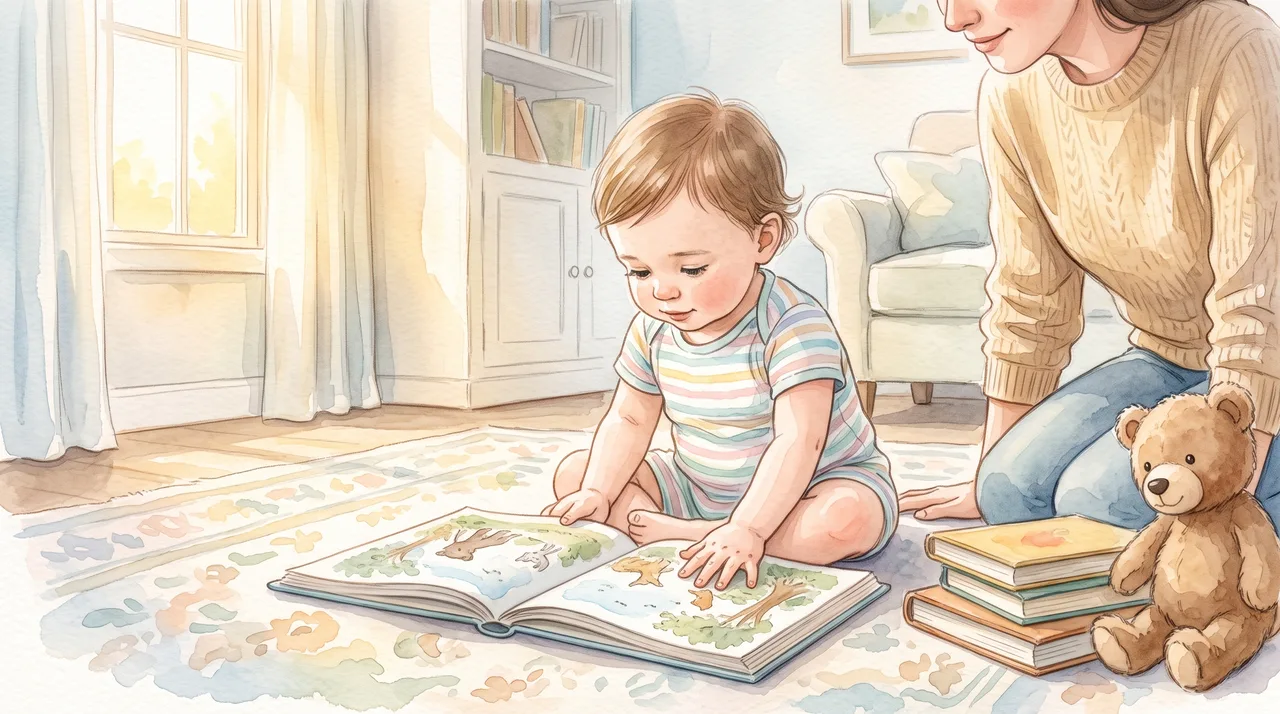
A one-year-old doesn't follow the plot. They look at the pictures, point, turn the pages (usually three at once) and respond to your voice. They recognise their own name long before they can say it — and at this age that's the part of a personalised book that really works. They hear their name in every other sentence, and there's someone in the picture who looks like them.
In practice: at one, you don't read the book, you name things in it. Instead of "Emma set off on a long journey beyond the horizon", say "That's Emma. Emma has a ball." Point, then wait for your child to point too. The text is for you, the pictures are for them. A year later you'll come back to the same book and read it as written.
A word about format, too. A printed A4 hardback is not a board book — a one-year-old will crumple a page and, with a little effort, tear it out. Read it together on your lap; don't leave it on the play mat. And keep the digital version for yourself at this age: the World Health Organization doesn't recommend screen time at all for children under two, while it explicitly recommends reading and storytelling together. The PDF is a backup for parents, not a reader for a toddler.
If you're choosing the book as a first-birthday present, have a look at gifts for a one-year-old and toys by developmental stage too — with one-year-olds, a gift that will "pay off in two years" is usually a gift for the parents.
Why the book grows with your child even though the text stays the same
Children outgrow an ordinary picture book. With a personalised one, what changes is what they take from it, because at every age they're looking at something different.
Around one, they see the pictures and hear their name. At three comes the question "Is that me?" — and with it the phase of wanting the same book every night; at this age repetition is a feature, not a chore. Around five or six they start recognising letters, and their own name is often the first word they read in a text; a book with their name on every page is a surprisingly rewarding first solo read. Later it becomes a keepsake: quite literally an artefact with a child's face, a dedication and a date.
Two things help that longevity in practice. The first is a dedication with the date and the name of whoever gave the book — without it, years later nobody remembers who it was from. The second is the audio version, for the phase when the same book comes round for the fifth time in a week and your voice is gone or you're behind the wheel; how listening differs from reading is covered in audiobooks for children.
What you shouldn't expect from a personalised book is that it replaces a bookshelf. It's one book in which your child appears — alongside it they still need stories where they aren't the hero, because that's exactly how they learn to put themselves in someone else's shoes. How to build a home library by age is summed up in books for children.
Dedications for a personalised book: wording to copy
The dedication is the one part the system doesn't write. Copy one, add the name and date — and above all, don't leave out the date; five years on it's the most precious detail on the page.
Five mistakes that make a personalised book disappoint
- A distant or backlit photoThe hero's likeness comes from a single photo. A group shot from a day out, a hat pulled down over the eyebrows or a shadow across half the face means the hero won't look like your child — and that's precisely why you bought the book.
- A nickname that wears thinUse the name you really call your child at home, but one that still reads well on every page. "Bubbles" gets old by the sixth or seventh sentence, long before the story does.
- A book in a baby's handsUnder two, children handle books roughly and test them with their teeth. A hardback isn't built for that — read together and keep the book in your hands. Board books are a different category altogether.
- Ordering at the last minuteThe digital book is ready within 15, but a printed copy has to be made and delivered (7). For Christmas, that's the difference between "I'll sort it tonight" and "should have ordered last week".
- Trying to cram the whole child into the storyList every hobby, friend and favourite food in the brief and you get an inventory, not a story. Pick one thing that captures your child and leave room around it for the plot.
Sources
- WHO: Guidelines on physical activity, sedentary behaviour and sleep for children under 5 years of age — Recommendations on screen time for children under two; reading and storytelling together are recommended as a good sedentary activity.
- Summer Reading Challenge (The Reading Agency) — A national campaign that encourages children to keep reading for pleasure through the summer holidays.
- BookTrust — A reading charity for families with young children; practical guidance on sharing books from babyhood onwards.
- Personalized book (Wikipedia) — An overview of the personalised book category and how it evolved from a name dropped into a template to today's form.