
Children's Books: How to Choose by Age and Interest
8/19/2026
How do you pick children's books they'll actually finish? A guide by age, from board books to first novels, and spotting quality without bestseller lists.
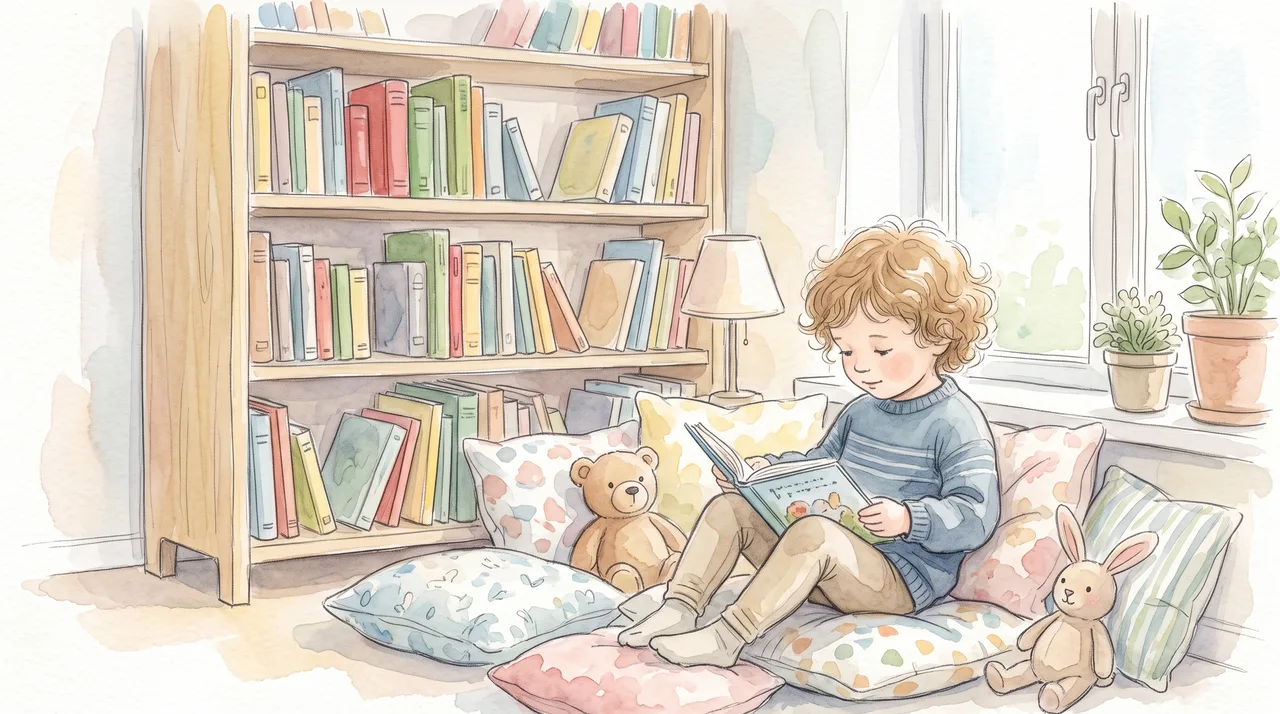
Choose children's books using three guides: your child's reading stamina (how much text they can handle in one go), a topic they picked themselves, and a hero they can identify with. Treat the age on the cover as a rough pointer only — children in the same school year can be several reading years apart. In the end, the most reliable test is simple: a good book is one your child finishes and then asks for another.
Choosing a book by age: a quick guide
Publishers' age bands are a useful first filter, but nothing more. So this table doesn't tell you what a child "should" be reading at a given age — it shows what usually works, and where parents most often go wrong.
If you're torn between two levels, go for the easier one. A book that's too easy entertains a child and boosts their confidence; a book that's too hard puts them off reading altogether.
| Age | What usually works | The most common mistake |
|---|---|---|
| 0–3 | Board books, nursery rhymes, pictures of animals and everyday objects | Long blocks of text — attention lasts only a few minutes |
| 3–6 | Read-aloud stories, short chapters, repeating patterns | Scary themes right before bedtime |
| 6–8 | Early readers: large print, short sentences, plenty of pictures | A thick book with no illustrations — it defeats them before they start |
| 8–10 | Adventure series, comics, non-fiction about their hobby | Pushing "worthy" books instead of ones they actually enjoy |
| 10+ | Fantasy, mysteries, stories about friendship groups and first crushes | Underestimating them — at this age children can handle demanding stories |
The best children's books aren't found on bestseller lists
Bestseller charts mostly measure marketing muscle, not whether a book will work for your particular child. Before you think about quality, though, check the difficulty — you can do it in the bookshop in two minutes:
- The five-word test. Open a page in the middle of the book and ask your child to read it aloud. Five or more words they stumble over or don't understand means the book is too hard to read alone. Two or three is ideal: they'll learn something without giving up.
- Paragraph length. For beginning readers, look for paragraphs of about three lines and sentences that fit on a single line. A solid block of text running past half a page is a visual stop sign for a six- to eight-year-old.
- Picture-to-text ratio. Early readers should have an illustration on every spread. For eight- to ten-year-olds one picture per chapter is enough, but a book with no pictures at all loses the reader who isn't confident yet.
- Chapters as portions. Check how many pages a chapter runs to. If one can be read in a single bedtime sitting, your child gets a sense of finishing something every day — and that's the engine that keeps them going.
Only then is it worth looking at awards decided by people who know the craft:
- The Carnegie Medals are the UK's best-known awards for children's books, with separate medals for writing and for illustration. The illustration shortlist is a good source of picture books for younger children, while the writing medal tends to suit confident readers from around ten upwards.
- The Caldecott Medal in the United States goes to the most distinguished picture book of the year — a reliable shortlist of read-aloud books for the youngest.
- The Newbery Medal, also American, honours writing for children and is judged on literary merit — winners are beautifully written and sometimes more demanding than you'd expect. They suit a child who already reads independently and enjoys it, less so a reluctant reader you're still trying to win over.
Then there are children's librarians: they lend books to hundreds of children a year, and when you ask "what are eight-year-old boys into right now?" they'll give you a sharper answer than any chart.
The final signal is at home. A book your child finished and then asked for the sequel of is a better book for them than an award winner lying untouched on the bedside table.
Books for 8–10-year-olds: when reading stops being a given
Ages 8 to 10 are a critical stretch for reading. Your child can already read, so reading aloud at home often stops — and with it the daily contact with books. This is when most "non-readers" are made. What reliably holds the attention of this age group:
- A series they're hooked onA series solves the hardest moment in a reader's life: what to read next. A child who finishes book one and asks for book two is set — the question "what now?" won't come back for another five volumes.
- Comics and graphic novelsComics are real reading, not cheating. For reluctant readers they're the shortest route to longer books: the pictures carry part of the story, so the text doesn't wear them out and success comes quickly.
- Non-fiction about a hobbyA child who refuses stories will often happily read about dinosaurs, space or football. Reference books can also be read in small bites — no need for the stamina to get through two hundred pages in one go.
- A story starring someone their ageAt this age, the heroes who pull children in are roughly as old as the reader. It's easier for a child to picture themselves in the story, which carries them through the first thirty pages while the plot is still warming up — and that's exactly where it's decided whether they'll finish the book. You can spot these titles in the library in seconds: the cover or blurb mentions the hero's age or school year, the story is set at school, at camp or in a group of friends, and it's told in the first person. The ultimate version is personalised books, where the main character is your own child — at Hero of the Book the illustrations are created from a single uploaded photo, so the hero actually looks like them.
Audiobooks for children: when they help and what they can't replace
Audiobooks win wherever a printed book can't be held: in the car, when a child is ill, while falling asleep after lights-out. Listening builds vocabulary, a feel for language and the ability to follow a plot, much as reading aloud does. What it can't replace is practice in reading itself — so for school-age children it works best alongside books, not instead of them.
A combination that works: your child listens to a story they already know from the page, or asks for the book to look through after listening. For bedtime listening, it's worth building audio into a fixed routine — we walk through how to put one together step by step in our article on bedtime stories.
When choosing an audiobook, look at four things:
- Track length by age. For preschoolers, choose titles split into chapters of around ten minutes, so listening can end at the end of a story, not halfway through. School-age children can manage a half-hour track; a full-length recording with no breaks, though, is hard to portion out night by night.
- The narrator's pace. Listen to a sample. A narrator who rattles through the text loses children under about seven — they need pauses between sentences to picture what they're hearing. A slower pace is a strength in children's audiobooks, not a bore.
- Full cast or a single voice? A dramatised production with music and several actors draws in reluctant listeners and works in the car, where it competes with background noise. For falling asleep, choose a single calm voice — sound effects and shouting characters will only wake your child up.
- Where to find them. Many public libraries lend audiobooks online through your library account, so you can try a title before buying it. For free read-aloud stories, BBC Sounds (CBeebies Radio) and Storynory are good places to start. For more on choosing by age and type of audio, see our guide to audiobooks for children.
How to raise a reader: five steps
Reading campaigns such as the Summer Reading Challenge and Read Across America all come back to one habit: reading regularly — ideally a little every day. Around that anchor you can build a whole system at home:
- 1Let your child chooseIn the library and the bookshop, your child picks and you just keep an eye on whether it's suitable. A book they chose themselves is several times more likely to be finished than one they "ought to read".
- 2Keep reading aloud to school-age childrenReading aloud doesn't stop once a child learns to read. You can read them books a level harder than they could manage alone — and that's exactly how you draw them into those books.
- 3Set up a bedtime routineSame time, same place, same order. A routine cuts down bedtime negotiations and turns the book into a signal that it's time to wind down — you'll find a concrete version in our article on bedtime stories.
- 4Leave books lying aroundA basket of books in the living room, a shelf within reach of the bed, a comic in the car. A book a child stumbles on by themselves gets read more willingly than one handed over with expectations.
- 5Praise finishing, not speedDon't compare them with classmates or siblings. Asking "so how did it end?" does more for their relationship with reading than praise for the number of pages read.
Where to get children's books without buying every new release
A child who reads gets through more books than it makes sense to buy. So it pays to split titles into those that only need reading once and those that should stay in the house. Four sources and the format that suits each:
Sources
- Summer Reading Challenge (The Reading Agency) — UK campaign that keeps children reading over the summer holidays.
- Carnegie Medals — UK awards for outstanding writing and illustration in children's books.
- Project Gutenberg — Free library of out-of-copyright books, including classic children's stories and fairy tales.
- Caldecott Medal and Newbery Medal — US awards for the most distinguished picture book and the most distinguished writing for children.