
Books for 8–10 Year Olds: Picks by Reading Stamina
8/20/2026
"Ages 8–10" on the cover describes a reader who barely exists. Picks for three real situations, and how to tell where your child fits right now.
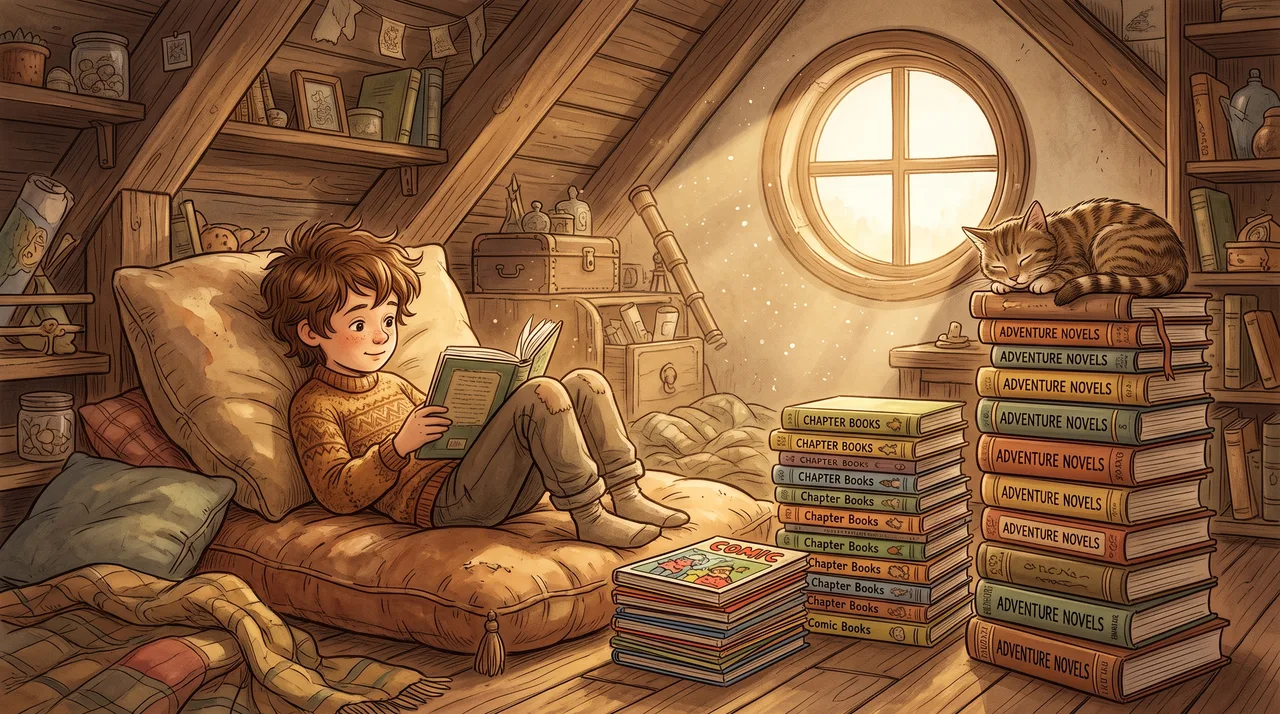
For children aged eight to ten, choose books by reading stamina, not by the age on the cover. A child who gives up after two pages will love a comic-style diary like Diary of a Wimpy Kid or Dog Man; a child who can manage a chapter a night will enjoy Nicholas or Fantastic Mr Fox; and a reader who devours a book in a weekend is ready for Harry Potter, The Wild Robot or The Chronicles of Narnia. A single school year group routinely contains all three kinds of reader at once.
Why the age on the cover isn't enough
An "ages 8–10" label describes an average that almost no real child matches. In the same classroom you will find a reader still sounding out text word by word sitting next to one who has already finished a seven-book fantasy series. Pick a book by age alone and you risk both kinds of failure: text that is too hard convinces a child that "books aren't for me", and text that is too easy bores and patronises them.
Stamina, on the other hand, is easy to spot — one evening of watching is enough, no tests needed. That is why the picks below are split into three groups according to how much a child can actually stick with, and at the end you will find a simple way to place your child. For broader choices by interests and genres, see Children's books: how to choose by age, interests and reading stamina; here we go straight to specific titles for school-age kids.
When a child reads two pages and stops
Short stamina doesn't mean a child can't read — they just need text they can nibble at. Books work where the pictures carry half the story, chapters are short and the jokes come fast:
- Diary of a Wimpy Kid (Jeff Kinney)Diary entries with doodles on every page and school humour any eight-year-old gets. The text is cut into small bites that make you read "just a bit more" — and there are so many books that the series lasts for years.
- Dog Man (Dav Pilkey)A comic about a police dog with a police officer's body. Wild humour and very little text make it a reliable hook even for kids who insist they "don't read".
- Tom Gates (Liz Pichon)A notebook full of scribbles, lists and jokes — a similar idea to Wimpy Kid, with a more artistic hand. A great second choice once the Wimpy Kid books are finished.
- Hilda (Luke Pearson)Comic adventures of a blue-haired girl among trolls, giants and spirits. A gentler, more visually rich alternative for kids who don't click with school humour.
- Captain Underpants (Dav Pilkey)Short, silly chapters packed with cartoons and flip-o-ramas. It can be read in any order, with no commitment, one chunk at a time — exactly what a reluctant reader needs.
A chapter a night: the first "real" books
Once a child can hold attention for a whole chapter, the classic "middle" shelf opens up: continuous text whose chapters work as self-contained episodes and can be read night by night without losing the thread:
- Nicholas (René Goscinny and Jean-Jacques Sempé)Short stories from school, each one done in an evening. The humour works read aloud too, so it suits taking turns between parent and child.
- Fantastic Mr Fox (Roald Dahl)A clever fox outwits three nasty farmers. A modern classic that manages to be funny and warm at once — and a perfect doorway to the rest of Dahl's books.
- The Children of Noisy Village (Astrid Lindgren)Gentle episodes from a Swedish village. Ideal for kids who don't need action but want to settle into a book and keep coming back to it.
- Magic Tree House (Mary Pope Osborne)Time-travel adventures in simple language with a quick pace. Being a series is a plus here: the child knows what to expect and reaches for the next book on their own.
- Pippi Longstocking (Astrid Lindgren)The strongest girl in the world, who does exactly as she pleases. Anarchy a child can at least read about, even if it isn't allowed at home.
For the reader who devours a book in a weekend
A confident reader between eight and ten can follow one plot across a whole book — and this is the moment that decides whether reading lasts into the teenage years. Offer worlds they can disappear into for entire series:
- Harry Potter and the Philosopher's Stone (J. K. Rowling)The early books are written for exactly this age; the later, darker ones a child can grow into. There's no need to rush the series — feel free to leave a gap between books.
- The Wild Robot (Peter Brown)A robot wakes up alone on a wild island and has to learn to survive among the animals. Gripping enough for keen readers, gentle enough for more sensitive children, with short chapters that keep the pages turning.
- The Chronicles of Narnia (C. S. Lewis)An entry into fantasy for the whole family. Start with The Lion, the Witch and the Wardrobe — it's the most accessible and works on its own.
- Ronia, the Robber's Daughter (Astrid Lindgren)Adventure, a friendship forbidden by the parents and a forest full of danger. A strong heroine and no magic — for kids who don't take to fantasy.
- Percy Jackson and the Lightning Thief (Rick Riordan)Greek myths transplanted into the present day, told with cheeky humour. For strong readers around ten, the ideal step between Harry Potter and books for older readers.
How to tell which group your child is in
You can work it out at home in one evening — no testing and, above all, no pressure. Your child doesn't even need to know you're watching.
- 1Have your child read one page aloudFrom a book that appeals to them. If they hit more than five words on the page they can't read smoothly or don't understand, the book is too hard for now — the so-called five-finger rule.
- 2Watch what happens after two pagesDo they keep reading on their own? They belong at least in the middle group. Do they put the book down, fidget, ask how much is left? Reach for a comic or a diary series and come back to longer texts later.
- 3Notice what they return toA book a child reads a second time is a better guide than one they were given and put aside. A series where they ask for the next book shows you've hit the right level.
- 4Check again in a few monthsReading stamina at school age grows in leaps. A book set aside in September may be a hit by Christmas — don't get rid of it, just put it back on the shelf where it can be seen.
Audiobooks for kids: reading with your ears counts
Listening isn't cheating or a substitute for reading. It lets a child absorb vocabulary and story structure above the level they can read alone — and that is exactly what makes reading with their eyes easier later. For reluctant readers a combination works well: listen to a chapter while following the text in the open book.
For free, try BBC Sounds (CBeebies Radio) and Storynory with read-aloud tales; audiobooks of most titles in this article are available from the usual audiobook services. A personalised book from Hero of the Book can also come with an audiobook for $3.99 — the whole story is narrated by a professional narrator (choose a male or female voice) and you listen right on the website. And if you mostly use audio at bedtime, have a look at bedtime stories with texts, audio and a routine that helps kids fall asleep.
Where to find more of the "best books for kids"
Online shop charts rank by sales, not quality. Awards where someone actually read the books are more reliable: the Newbery Medal and the Caldecott Medal in the United States and the Carnegie Medals in the United Kingdom. Recent winners and shortlists make a ready-made shopping list for when the titles in this article run out. Reading campaigns such as the Summer Reading Challenge from The Reading Agency or Read Across America are another good source of ideas.
One last tip: take your child along to choose, whether to the library or the bookshop. A book they picked themselves has a much better chance of being finished than the best-reviewed one handed to them ready-made. At home it helps to keep books within reach — their own shelf at eye level does more for reading than any reminder.