
First birthday keepsakes: what lasts after the toys
8/29/2026
Choose a first birthday gift by what will be left in ten years: a handprint, engraved jewellery or a book with your child as the hero.
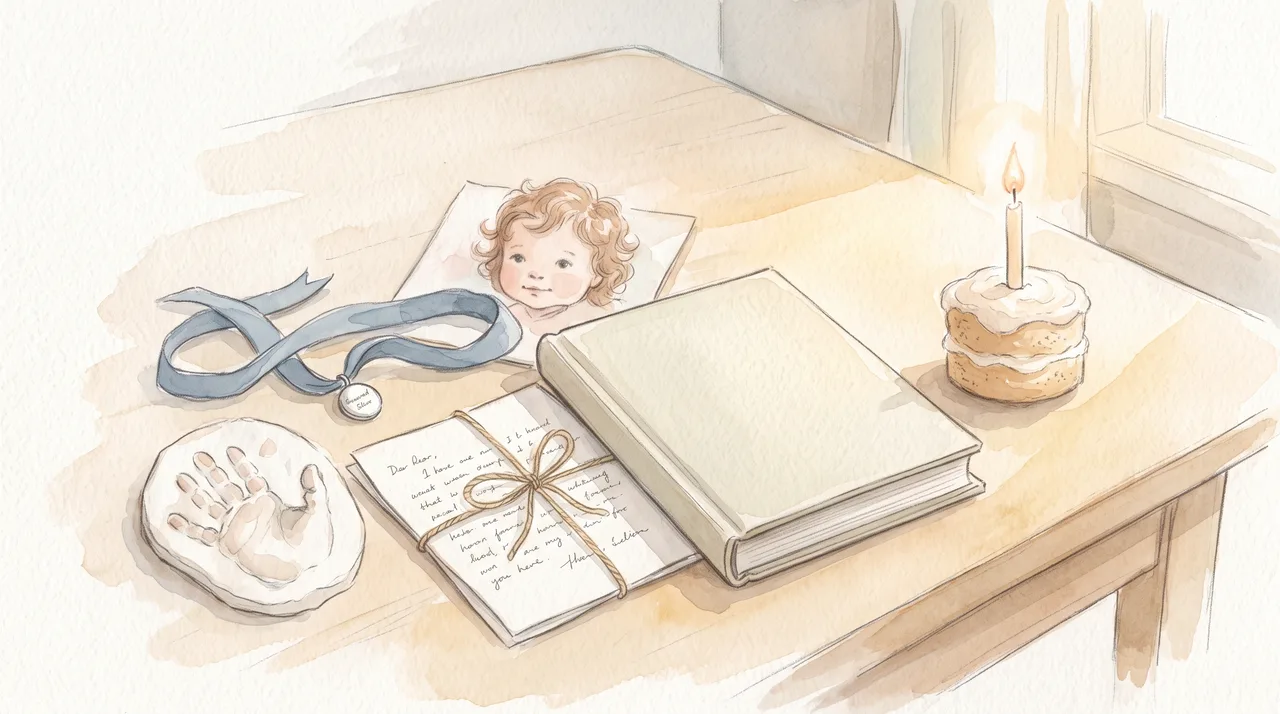
A keepsake gift for a first birthday has a different job from a toy: it is not meant to entertain the child but to outlast childhood. Four kinds last longest — a handprint or footprint, an engraved piece of jewellery with a name and date, a letter or time capsule, and a personalised book in which the child is the hero. Choose based on who will be looking at the gift in ten years: the parent, or by then the child.
Chapters of this guide
This guide gives the overview; the detail lives in the individual chapters. Here is the map, so you know which part you need.
Why a keepsake is chosen differently from a toy
A one-year-old does not choose the gift and will not remember it a few months later. So the audience for a keepsake is different from the audience for a toy: it is looked at by the parents, the grandparents and one day the child too, once they can read what people wrote to them on their first birthday.
That leads to one practical rule: ask yourself what will be left of the gift once it stops working. A toy is done the moment the child outgrows it, and with a one-year-old that is a matter of months. A handprint, an engraved pendant or a book with their name in it have no function to outgrow — their value on the day you hand them over is almost nothing, and it only grows with time.
That does not mean you shouldn't buy a toy. It means a toy and a keepsake are two different gifts, and there is no point looking for one that does both: you usually end up with a worse toy and a worse keepsake. What will delight a one-year-old right now is covered in a gift for a one-year-old based on what they can already do.
And one more thing people realise too late: what makes a keepsake is being able to date it. An unlabelled print is, ten years on, a pretty cast of an unknown child at an unknown age — especially with a second or third sibling.
A handprint that won't crumble within a year
A cast is the most common first-birthday keepsake, and also the one that most often ends up cracked in a box. Most failures come down to one of two causes: the wrong moment, or drying it too fast.
- 1Choose the material based on where it will hangAir-dry clay is cheap and needs no kiln, but it is soft and wears over time — it belongs in a frame behind glass. Plaster can sit unprotected on a shelf. An ink print on paper is the easiest and quickest, but direct sunlight kills it; keep it in a folder, not on the wall.
- 2Pick the right hour, not the right dayMake the print when the child is fed and rested, ideally shortly after a meal. A hungry or sleepy child won't open their hand, and a clenched fist won't leave a print.
- 3Prepare two batches of materialThe first attempt almost never works, and the material is setting in the meantime. The second batch decides whether you end up with a print or just a memory of trying.
- 4Press while the child is lying down and guide the hand by the wristLay the child down, hold the material under their hand and press at the wrist, not the fingers. Pulling on the fingers smudges the print and the child won't like it.
- 5Label the back before the cast driesName, date and which hand. It seems pointless while you still know — and it is the only information that cannot be worked out from the cast ten years later.
- 6Let it dry away from radiators and sunlightDrying too fast is the most common cause of cracks. Leave the cast in a shady spot at room temperature for several days if needed, and turn it over so it dries from both sides.
Jewellery with a name: what to engrave and why the child doesn't wear it
An engraved pendant, bracelet or tag with a date of birth is a gift for an adult to pass on to the child later. A one-year-old should not wear jewellery like this: a chain around the neck is a strangulation risk and a small pendant a choking risk, and both are at their highest exactly when the child puts everything they grab into their mouth.
It is worth knowing that baby jewellery is not a toy. The European toy safety rules apply to products intended for play by children under fourteen, so toy standards do not cover baby jewellery and its seller does not have to prove anything under them.
The practical conclusion: buy the jewellery, but put it away — in a box with a note saying who it is for and when to hand it over. Safety filters for things you actually put in a child's hands are covered in gift safety for the youngest.
And about the engraving: engrave the name and date of birth, not the year of giving or a line about the giver. "From Granny Jane" loses its meaning the moment the child no longer knows which granny that was; a date of birth never goes out of date.
Five keepsakes side by side: what is really left after ten years
The table doesn't compare which is prettier — it compares what destroys the gift and who will look at it in the future. The second point decides whether the keepsake stays in a drawer or one day gets handed on.
| Keepsake | When to make it | What destroys it | Who will look at it |
|---|---|---|---|
| Handprint or footprint | Before the party, not on a busy day | Fast drying, sunlight, no label | Parents and grandparents; the child only as a teenager |
| Engraved jewellery with name and date | Any time; it is handed over many years later | A lost box, an engraving tied to the giver | The teenager, once they receive it |
| Personalised book with the child as the hero | A few days ahead, so it is ready for the party | Nothing in particular; paper and file survive house moves | The child, as soon as they start listening to stories |
| Letter to the future or time capsule | Around the birthday itself, while you still remember the year | A forgotten hiding place, a damp basement | The child, on a day you choose in advance |
| First-year photo book | Once the year is over, not as you go | Putting it off, thousands of unsorted photos on the phone | The whole family, again and again |
Words to copy: engraving, letter to the future, dedication
With a keepsake gift, the wording trips people up more often than the choice. These lines are ready to copy — fill in the name and date and leave the rest. Longer book dedications and common mistakes are covered in book dedications.
A book in which that particular child is the hero
A personalised book is the only one of these keepsakes that a child uses before understanding that it is a keepsake. A one-year-old doesn't understand a book, but at two they recognise themselves in the pictures and at four they ask to hear the story in which they are the hero — and that is exactly when the gift starts to pay off.
Compared with a cast or jewellery, it has one practical advantage: it is a keepsake and an everyday object at the same time. The book gets read, lent to nursery and worn, yet the dedication dated on the first birthday stays inside. The risk is the opposite of a cast — not that it breaks, but that someone writes a generic greeting in it that could have gone to anyone.
How a book with a specific child as the hero is made is explained in a personalised book for your child. At Hero of the Book it is made from a single uploaded photo, is usually ready in about 15 and has 12 illustrated spreads; before you pay you will see a suggested title, a story preview and the dedication, but not the finished illustrations. For a first-birthday gift that means one practical precaution: don't leave it until the day of the party.
Four keepsakes that age worse than you expect
Not every gift sold as a keepsake stays one after a few years. These four fail most often, and all for the same reason: they depend on something that will change within ten years.
- A digital photo frame or a tablet "for little ones"The device becomes obsolete before the child grows up, and a screen is a poor gift for a one-year-old in its own right: the World Health Organization does not recommend any screen time at all for children under two. Photos belong on paper or in a backup, not in a frame that in a few years won't even hold a charge.
- Photos only in the cloud and on a USB stickAccounts get closed, sticks get lost, formats change. The cloud is a backup, not a keepsake — a keepsake is something you can pick up without hunting for a password.
- A first-tooth capsule and a lock of hair without a labelThey work fine on their own, but without a date and name they get mixed up with the first child's once a second sibling comes along. Always label the box, not the lid — lids get swapped.
- A gift the parent has to finish for the child"Fill in the first year" sets with dozens of boxes stay blank from page three onwards. If you give one, pick the shortest; an unfinished baby journal is a worse keepsake than one page that is actually filled in.
Sources
- Directive 2009/48/EC on the safety of toys — Scope of the toy rules: they apply to products designed or intended for play by children under fourteen. Baby jewellery is not among them.
- WHO: Guidelines on physical activity, sedentary behaviour and sleep for children under 5 years of age — Recommendations for children under five; for children younger than two, screen time is not recommended.