
Time capsule and a letter to the future: what and when
9/2/2026
A time capsule in one afternoon: what goes in, how to write a letter to the future and when to open it so it can still be read.
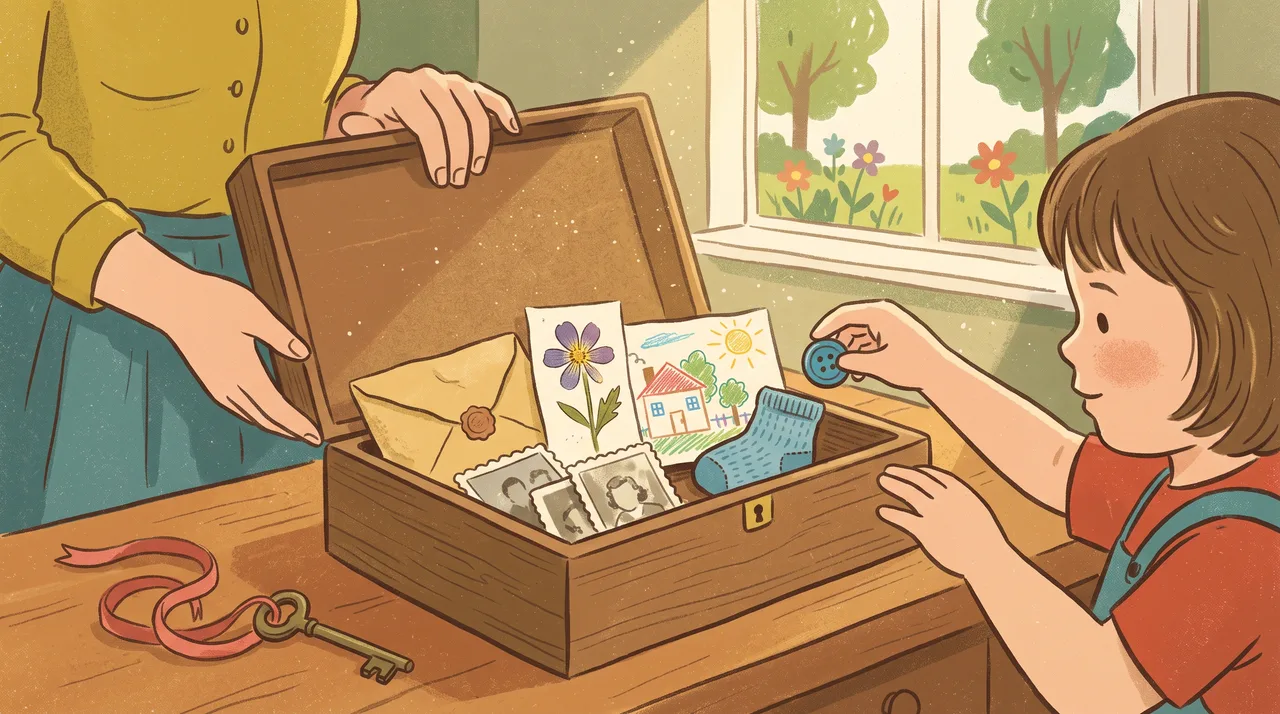
A time capsule is a sealed box of things from today that the family opens on a date agreed in advance, and a letter to the future is the most valuable thing it will hold. You can build one in a single afternoon: a well-sealing box or tin, three to five objects that look completely ordinary today, printed photos and a handwritten page about what life is like at your house right now.
The one decision worth making at the very start is the opening date. Write it on the outside of the lid and put it in the family calendar, otherwise someone will open the capsule “just to peek”, or it will be forgotten about in ten years.
A time capsule in one afternoon: step by step
The order is not accidental. Most capsules that end up unfinished in a drawer fall apart at the stage where everyone collects pretty objects and the letter gets put off until later.
- 1Agree on the opening dateBefore you collect anything, say out loud when the capsule will be opened: a specific year, ideally tied to an event (an eighteenth birthday, the end of primary school, ten years from today). The date decides everything else, above all how carefully the capsule needs to be stored.
- 2Choose the container to suit where it will sitFor a wardrobe, a sturdy box with a lid or a metal biscuit tin is enough. For a cellar, a garage or the ground, only a container that genuinely seals will do, because damp is more dangerous to paper and photos than time is. Pick a container two fingers larger than the biggest sheet of paper going into it: nothing should have to be folded to fit.
- 3Write the letter firstThe letter is the one thing nobody else will write. Give it twenty minutes and a single sheet, not a half-filled notebook.
- 4Add three to five everyday objectsNot the prettiest things you own, but the most ordinary ones: a bus ticket, a shopping receipt, a drawing made that day, a torn-off cinema listing. In ten years it is exactly this everyday material that is interesting, not a ceremonially chosen souvenir.
- 5Print the photos and note who and when on each onePhotos on a phone never make it into the capsule. Print five to ten shots and write the name, place and date on the back in soft pencil. Without captions, half the people in the photos will be unidentifiable in fifteen years, even to their own family.
- 6Write a list of contents and stick it on the outsideTwo things belong on the lid: the opening date and a short list of what is inside. The list stops anyone opening the capsule early just because they cannot remember whether there are documents in it.
- 7Seal it and tell one more person about itA capsule only one person knows about gets lost in the first house move. Tell your partner, a sibling or a grandparent, and add a note to the family documents.
A letter to the future: paragraphs to copy
The first sentence is the hardest. The paragraphs below are there to be copied and filled in; replace the brackets with your own words. The best letters are not wise, they are specific: the price of a bread roll, the childminder’s name, the sentence your child kept repeating that week.
What belongs in the capsule and what will ruin it in ten years
- Paper that looks worthless todayA receipt with prices on it, a bus ticket, a leaflet from an after-school club, a school timetable, a printed order confirmation. This is exactly what gets read most years later, because nobody keeps it. Thermal-paper receipts, though, fade to blank within a few years, so photograph them or copy the amount onto the edge in pencil straight away.
- A hand outline, a height mark, a dated drawingA hand traced onto paper weighs nothing, and ten years on it is the most convincing proof of how small your child was. A more durable version is a hand or foot cast, which deserves its own wrapping so it does not rub against the papers in the box.
- Printed photos, not just filesA printed photo is the only thing in the capsule you need no device to open. Keep the photos in their own envelope rather than loose among the papers, ideally in a sleeve labelled acid-free.
- Sound, if you can store it twiceA recording of a child’s voice or a bedtime story being told is the most powerful thing in the capsule and also the most fragile. It belongs in the box only as a spare copy; the main copy has to stay outside, on a drive that is in regular use.
- Nothing that can leak, rot or swellSweets, seeds, perfume, a balloon, rubber toys, batteries. Rubber and balloons break down into a sticky mess, and batteries leak and corrode everything around them. A flower can go in only dried and interleaved with clean paper.
- Newsprint and sticky tapeA newspaper from the day of the birth is a lovely idea, but acidic newsprint yellows and prints itself onto everything lying next to it. Put it in a separate envelope. Never repair photos or documents with sticky tape — the adhesive seeps through over the years.
- The only copy of anythingThe capsule is no place for the only existing print of a photo, the only original of a document or a flash drive holding the only copy of a video. A capsule is a gift, not an archive.
When to open it: four dates and what suits each
| Opening date | Who it suits | What to add | What to watch out for |
|---|---|---|---|
| In a year, for the next birthday | A preschooler, for whom a year is an eternity | A height mark, a drawing, a photo from the same spot at the same angle | A short gap means little change. Make it a series and top the capsule up every year. |
| In ten years | A schoolchild who will open it as a teenager | A list of friends, favourite songs, the prices of everyday things, a copy of the weekly timetable | It has to survive a house move too. Label the box on the outside and add a note about it to the family documents. |
| For an eighteenth birthday | A newborn and a letter from their parents | The hospital wristband, a separate letter from each parent, a newspaper from the date of birth | The longest window makes the biggest demands on storage. Put newsprint in an envelope of its own. |
| For a wedding or the birth of their own child | Grown-up children, with grandparents as the writers | A family recipe, a photo of the house, a letter about what life was like before the children came | The date is not certain and may never come. Write a fallback date on the lid as well, a thirtieth birthday for instance. |
Where to keep the capsule so it can still be read years later
The enemy is not time, it is damp and swings in temperature. For family papers and photos the US National Archives recommends keeping the temperature below 24 °C and relative humidity below 65 %, because mould grows above that line, and at the same time avoiding very dry conditions below 15 % humidity, where paper turns brittle. A damp cellar, a garage and a baking loft are therefore the three worst places, even though they are the ones people choose most often.
A good spot is inside the home: the top shelf of a wardrobe, the space under a bed, a storage cupboard. Put the box on a shelf rather than straight on the floor, and away from pipes, windows and anywhere that has leaked before. Inside, use acid-free enclosures and folders with a low lignin content, and never bend anything to make it fit. If the box is half empty, pad it out with clean paper so the contents cannot slide around.
Burying it in the garden is possible, but it is a different discipline: you need a genuinely watertight container, a depth below the frost line, an exact fix on the spot and the certainty that the plot will still be yours in ten years. Most families are better served by a box in the wardrobe.
And the last thing people forget: what you write with. An ordinary soft pencil and pigment ink last; gel pens, highlighters and stamp ink fade. Always write on the back of photos in pencil, and lightly. Handle photos and negatives with gloves or at least by the edges, because fingerprints on them stay for good.
A digital letter to the future: an e-mail that arrives on its own
There are services that will send an e-mail to you or to someone else on a date you set in the future; the best known is FutureMe. Writing a letter like that takes ten minutes and costs nothing. It does have two weak points to reckon with: the mailbox the letter is aimed at has to survive (an address from an employer or a phone operator will not survive anything), and the service itself has to survive. For a five-year horizon it is a fine idea; for an eighteen-year one, paper is more reliable.
The digital part of the capsule deserves the same rule that the National Archives and the Library of Congress recommend for family archives: three copies, on two different media, one of them off-site. A flash drive shut inside a box meets none of that, because it is a single copy on a single medium in a single place. Whatever digital material you put in the capsule, keep the main copy outside it, in a folder you use and back up routinely, and name the files so they make sense without you: date, name, event.
What still gets read after the capsule is opened
A capsule is opened once. Much of what is inside is spent at that moment: the ticket gets read, the family laughs at it and it goes in the bin. A few things survive the opening, though, and the family goes on using them. Those are the ones worth reaching for if the capsule is meant to be a gift and not just a moment.
Three work best: the letter (read over and over, above all by children whose letter was written by someone who is no longer here), printed photos with captions and something with a date engraved on it, such as jewellery with a name and date or another keepsake gift that can be worn or stood on a shelf.
A fourth option is a book. A personalized book with your child as the hero opens with a blank page for a dedication, and that is a letter to the future with a cover and a spine: the child reads it alone once they can read, and the book stays with them on a shelf instead of in a box. The dedication can be written in a single evening, the digital version of the book is usually ready within 15 and the story runs to 12 illustrated spreads. If you are stuck on the wording, the common mistakes and texts to copy are in the article on what to write in a dedication; in both cases the same rule applies as for the letter in the capsule — a specific date and one real memory beat a general wish.
Sources
- National Archives (USA): Storing Family Papers and Photographs — Recommended storage conditions for family papers and photos — temperature, relative humidity, acid-free enclosures and why to avoid the cellar, the garage and the loft.
- National Archives (USA): Digitizing Family Papers and Photographs — The rule of three copies on two media with one kept off-site, how to name files, and why to keep the originals even after scanning.
- Library of Congress: Personal Digital Archiving — How to look after digital photos, e-mails and recordings so they can still be opened years later.
- FutureMe — A service that sends an e-mail to your future self on a date you choose; an example of what the digital version of the letter looks like.