
Gifts for Preschoolers: Ideas by What Your Child Is Learning
10/2/2026
From four to six, preschoolers practice talking, independence, pretend play and hand skills for school. Here are gifts sorted by what is growing now.
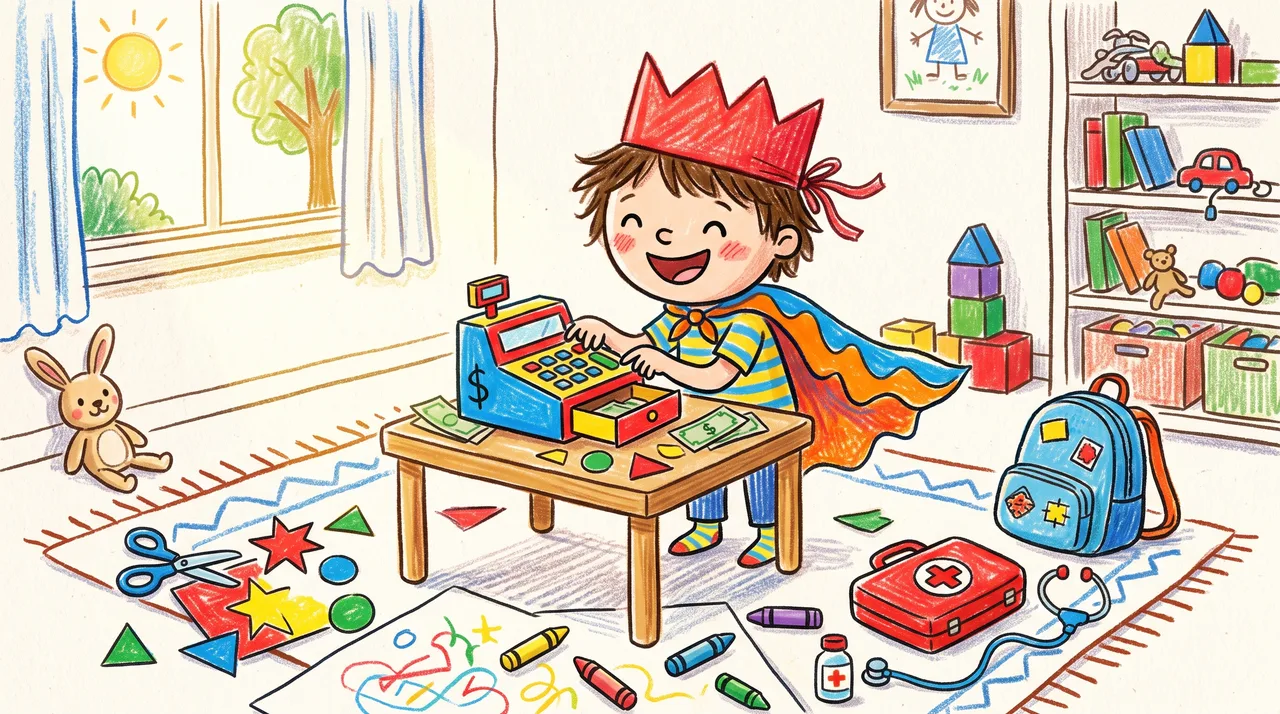
The gift a preschooler loves most is one that hits the skill they're working on right now: language (storytelling games, puppets, books with a real plot), independence (a kid-safe knife, their own backpack, a stoplight alarm clock), pretend play (costumes, a play store, a doctor kit) or getting ready for school (scissors, crayons, board games). Before you choose, spend a few days watching what your child keeps repeating on their own and where they get stuck — that's a better guide than the age printed on the box.
Chapters in this guide
Gifts for language and storytelling
Between four and six, a child who used to name things becomes a child who tells stories: they string events together, ask "why?" and start playing with words. Early learning programs treat language as one of the core areas to work on at this age. So look for gifts that make the child talk — not ones that talk for them.
- Story cubes and cardsDice or cards with pictures that combine into a story: a hero, a place, a problem. Your child has to link three pictures into one plot with "and then…". It works with just two players, too, when the grown-up only asks questions.
- Books with a plot, not just picturesBoard books with one word per page no longer hold a preschooler's attention. Look for stories with a simple plot that kids can come back to and retell in their own words. There's more on choosing in our article Books for kids: how to choose by age.
- Hand puppetsThrough a puppet, a child will say things they wouldn't say out loud themselves. Two puppets beat one — you get a conversation, not a monologue.
- Word gamesRhyming cards, riddles or simple first-sound games. For a child who struggles with pronunciation, it's gentle practice — but it doesn't replace a speech therapist.
Gifts that build independence
Preschoolers want to do everything "by myself" — they just lack things in their size. A good gift here isn't a toy but a real tool scaled down for a small hand. By the time school starts, kids are expected to handle basic self-care: get dressed, clean up after themselves and look after their own things.
- Kitchen tools that actually cutA kid-safe knife with a blunt tip for bananas and cooked carrots, a small cutting board and a step stool for the counter. A child who slices their own snack is prouder of it than of any new toy.
- Their own backpack and water bottleA backpack they can zip up and carry themselves is practice for a school bag. Test the zipper or buckle right in the store — your child has to manage it without help.
- Stoplight alarm clockA clock that uses colors to show when it's okay to get up teaches a sense of time before a child can read clock hands.
- A place of their own for thingsA treasure box, a coat hook at the child's height or shelves labeled with pictures of what goes where. Tidying up starts with things having a place to go.
Pretend play: costumes, store, doctor's office
Make-believe peaks in the preschool years. Kids try out what it's like to be a doctor, a cashier or a firefighter, and along the way they practice negotiating, taking turns and following rules. Props should be open-ended: the less a prop does on its own, the more the child imagines.
- Doctor kitA stethoscope, bandages, a syringe with no needle. It helps before a doctor's visit or shots, too — your child can play out the fear on a stuffed animal.
- Play store with a cash registerA register with paper money, a scale and a few empty food boxes. Counting, adding and making change happen along the way.
- Costumes without a movie licenseA cape, a crown, a helmet, an apron. A generic costume can carry hundreds of stories; a costume of one fairy-tale character only carries that one — and usually gets boring within six months.
- Play tent or playhouseA fabric tent or a big cardboard box turns into a castle, a rocket or a doctor's office. Preschoolers love a space where grown-ups aren't allowed.
Getting ready for school: hands, focus, numbers
The year before kindergarten is a good time to build school-readiness skills, and the school year starts in late August or early September. Don't buy workbooks as a gift — kids recognize them as homework. Better choices are things that train the hand and attention span without the child knowing it.
- Kid scissors and colored paperCutting strengthens the same small hand muscles that will later hold a pencil. Buy scissors that really cut (left-handed ones for lefties) and a stack of paper for cutouts.
- Triangular crayons and big paperThick triangular crayons guide fingers into the right grip. A big sheet spread on the floor is better for drawing than a small notebook — the arm moves freely from the shoulder.
- Simple board gamesGames with dice and pawns, or memory matching, practice counting dots, waiting for your turn and, above all, losing. That last one is the most valuable part.
- Building sets with instructionsBuilding from picture instructions teaches following steps one at a time — exactly what kids will face with every assignment at school.
How to tell which skill your child is working on
The age on the box is mainly about safety — more on that in Gifts for little kids: what to avoid. Whether a gift actually clicks depends more on what's developing right now. If you're shopping for several kids at once for Christmas, Christmas gifts by age and type can help too.
| What you notice | What your child is practicing | A gift that fits | What to skip |
|---|---|---|---|
| Keeps asking "why?" and tells you what happened at preschool | language and storytelling | story cubes, puppets, a book with a plot | toys that talk for the child |
| Says "I can do it myself" and gets upset when you help | independence | kid-safe knife, their own backpack, stoplight alarm clock | toy dishes that can't do anything |
| Dresses up and hands out roles, including to you | pretend play | generic costume, doctor kit, cash register | a costume of one movie character |
| Draws, wants to write their name, counts stairs | getting ready for school | scissors, triangular crayons, board games | workbooks full of tasks as a gift |
| Can play alone for a long time | focus | building set with instructions, puzzles with more pieces | electronics that reward every few seconds |
A book as a gift for a preschooler
A book is a gift that reaches several areas at once: it grows vocabulary, offers roles to act out and teaches kids to follow a story from beginning to end. For a preschooler, what works best is a story they can see themselves in — a hero their age, with the same fear of preschool or the same dog.
The ultimate version is a book where your child is the hero. A personalized book is made from a single photo and a name that runs naturally through the whole story; our article A personalized book for your child explains how it works. If your child would rather listen than look at pictures, an audiobook is a great match — you'll find listening tips in Audiobooks for kids. And since a preschooler will read the dedication on their own in a few years, it's worth writing thoughtfully: get inspired by Book dedications: messages to copy.
For a last-minute gift, timing is everything. The digital version is usually ready within 15 minutes and has 12 illustrated spreads, so you can make it even on the day of the party and print it at home. The hardcover print edition arrives in 7 business days, so plan ahead — especially before Christmas and before birthdays that fall on a weekend.