
Getting Ready for School: Gifts That Teach Through Play
10/3/2026 · The Hero of the Book Team
School prep doesn't have to mean workbooks. Gifts that build a preschooler's hand skills and attention without them knowing they're learning.
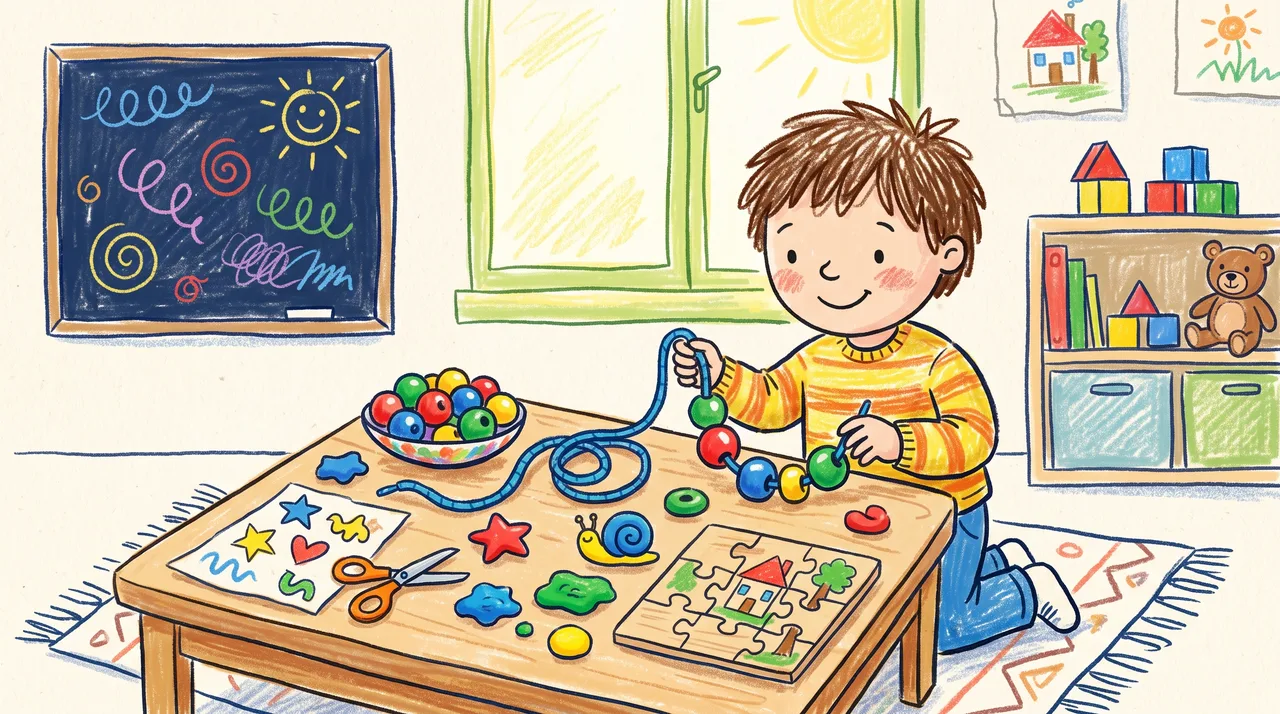
Getting a preschooler ready for school isn't about learning letters ahead of time. It's about a relaxed hand, a good pencil grip, the ability to stick with one thing for a while and to listen carefully. All of that is best practiced through play: stringing beads, cutting, play dough, seek-and-find books, memory games or listening to stories. A well-chosen gift does more than a workbook you have to coax your child into.
What school really expects from a preschooler
Schools don't expect a child to read or count to a hundred before the first day. What teachers count on are the skills that reading and writing are later built on.
The hand. A new student will be writing several times a day. That takes finger strength, a relaxed wrist and shoulder, and a three-finger grip (thumb, index and middle finger). A child who holds a crayon in a fist and presses hard tires quickly and starts to hate writing.
The eye and attention. Telling b from d, spotting the difference between two pictures, following a line from left to right. This is called visual discrimination, and it can be practiced without a single letter.
The ear. Hearing which sound a word starts with, clapping out syllables, repeating a short sentence. Listening skills matter for reading just as much as eyesight.
Staying power. At school, kids sit and work on tasks they didn't choose. A preschooler who can stay with a puzzle for ten minutes has a head start.
The gifts below target exactly these four areas. For a wider selection by age and development, see gifts for preschoolers based on what they're learning.
Gifts that train the hand
| Gift | What it quietly trains | What to watch out for |
|---|---|---|
| Triangular crayons and big sheets of wrapping paper | the three-finger grip, big relaxed strokes from the shoulder | small paper tempts kids to draw from the wrist and press too hard |
| A magnetic board or chalkboard on the wall | drawing standing up loosens the shoulder and elbow, so the hand doesn't lock up | the board should be at your child's eye level, not overhead |
| Play dough or homemade salt dough | finger and palm strength: kneading, rolling, pinching | stiff dough puts kids off — start with a soft one |
| Beads and laces for stringing | hand-eye coordination, the pincer grip | smaller beads only for kids who no longer put things in their mouth |
| Kids' scissors with a cutting activity book | using both hands together, smooth movement along a line | left-handed scissors for a lefty — regular ones hide the line |
| A peg mosaic or a hammer-and-nail set | precise gripping of small pieces, planning a pattern | keep the pattern simple, or the game turns into a task |
| A building set with smaller pieces | fine motor skills, spatial thinking, staying power | instructions are a bonus — free building is just as good for the hand |
Gifts for attention, sight and hearing
- Seek-and-find and big picture booksPages packed with detail where you hunt for a particular character or object. Your child practices scanning a picture systematically — exactly what they'll need later to follow a line of text.
- Memory games and quick-reaction card gamesMemory teaches kids to remember positions; fast games about finding the matching symbol build quick reactions. Two players can finish a round in five minutes, which is the perfect length for a preschooler.
- Puzzles with twenty to a hundred piecesPutting a puzzle together means comparing shapes, colors and edges — visual discrimination in its purest form. Start with a piece count your child can do alone and add more gradually.
- Mazes and dot-to-dot coloring booksGuiding a line through a maze or connecting numbered dots is a step toward writing. Unlike warm-up drills in a workbook, it feels like a puzzle.
- Audiobooks and listening to storiesListening without pictures makes a child keep the plot in their head. Afterward, ask what happened first and what happened at the end — that trains listening memory and the order of events. Tips on keeping listening away from screens are in the article on bedtime stories.
- Rhythm instrumentsA small drum, rhythm sticks or a tambourine. Clapping and drumming out syllables is one of the first things kids do in early reading lessons, and at home you can turn it into an echo game.
A book where they look for themselves
A preschooler who can't read yet comes back to a book for the pictures. When they are the main character, they look more closely: they find themselves on every spread, check whether their sister or the dog is there too, and recognize their own name in the text before any other word. The first letters a child truly knows are usually the ones in their own name.
A personalized book from Hero of the Book is made from a single photo — the hero in the illustrations looks like your child, and you can add siblings, friends or a pet to the story. The book has 12 illustrated spreads, the digital version is usually ready within 15 minutes, and you can add an audiobook, so your child can listen to the same story too. You choose the theme — even an adventure about the first day of school your child is nervous about. How such a book comes together is described in a personalized book for your child.
How to give the gift so it doesn't feel like school
- 1Don't call it practice"This is so you'll learn to write" turns play into a chore. A gift is a gift — the scissors are for making a crown, not for training.
- 2Play along for the first few daysA preschooler is more likely to dive into something new when they see you enjoying it. Ten minutes together is enough; then let your child carry on alone.
- 3Don't correct the grip mid-projectIf your child holds the crayon wrong, offer a triangular or shorter one (a short crayon naturally pushes toward a finger grip). Correcting them out loud while they draw spoils the fun.
- 4Notice what pulls them inOne child will spend an hour with beads and find cutting boring; for another it's the opposite. Add more of what they enjoy and try the other thing again in a few weeks.
- 5Give things a permanent spotA box with play dough, scissors and paper within reach means your child will start crafting on their own, without being asked. That's exactly the independence they'll need at school.
Dedications for a gift before starting school
Looking for high school or college entrance exam prep?
Plenty of people searching for "school prep" are actually looking for help with entrance exams, standardized tests or college admissions. That's a completely different discipline from starting school, and the gifts in this article won't help with it. For standardized tests, the most reliable material is the official practice tests published by the organization that runs each exam; college admission requirements are set by each school, and you'll find them on its own website.