
Sound Books for Kids: How to Choose by Age and Sound Type
8/24/2026
Chip, reading pen, audio player or QR code? Which sound books suit which age, and what to ask so the audio doesn't pull kids away from the words.
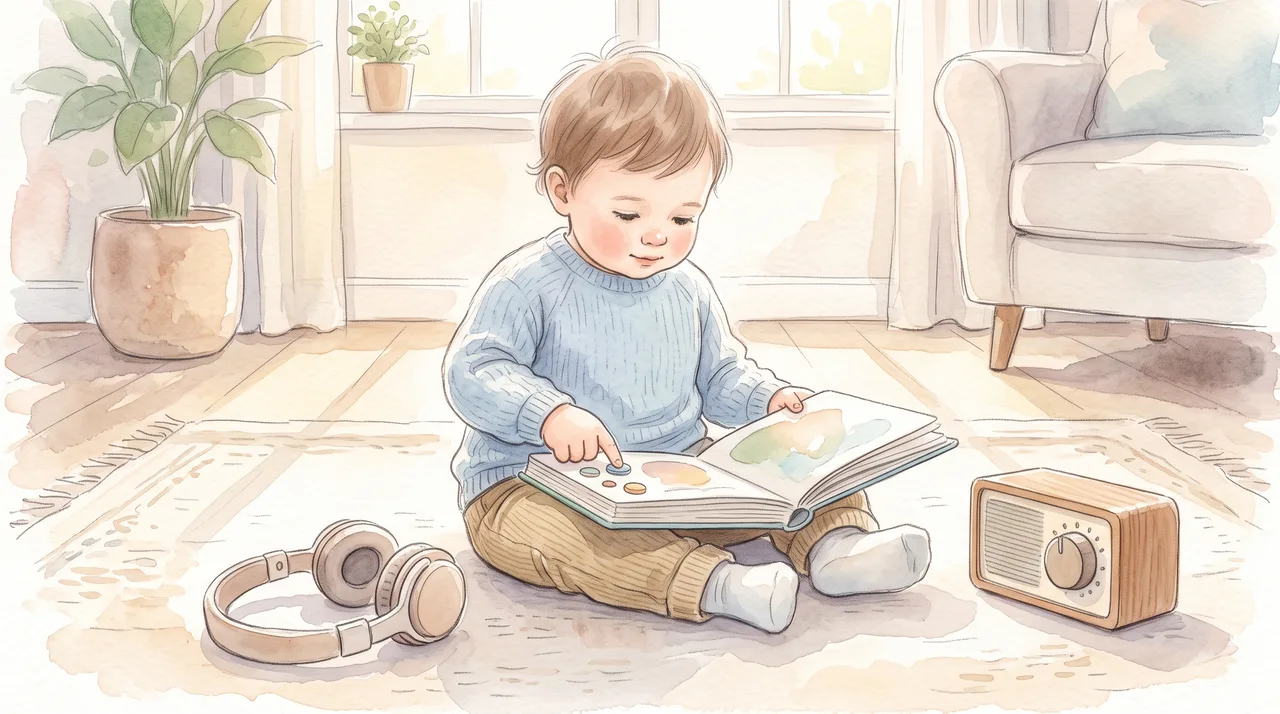
Four quite different things are sold as "sound books": a board book with a chip and buttons, a book that works with a reading pen, a book paired with a separate audio player or figure, and a book with a QR code that plays on a phone. Toddlers do best with buttons, preschoolers with a pen or a screen-free player, and school-age kids who already read on their own with a recording of the same text that can be switched off at any time. Before you buy, ask three things: can the sound be turned down, how do you change the battery, and does the narration match the words on the page?
Four kinds of sound books and how they differ
Online they all look the same — "sound book" — but you're buying four very different products. The type decides how much your child can play alone, who controls the volume, and what's left of the book once the electronics die.
| Type | Can use alone | What it does well | Where it falls short |
|---|---|---|---|
| Board book with chip and buttons | from about 18 months | the sound is built into the book, nothing else needed | short loops on repeat, volume is often fixed |
| Book with a reading pen | from age 3 | plays exactly the spot your child points to | the pen costs more than the books and only works with one series |
| Book with an audio player or figure | from age 2 | screen-free listening, kids start and stop it themselves | sound and page drift apart easily — the child listens and puts the book down |
| Book with a QR code or app | from age 6, earlier only with an adult | nothing extra to buy, narration is often professional | it plays on a phone, a device full of notifications and the temptation to switch apps |
Sound books by age: what kids actually do with them
The age on the cover is about safety and page size. Whether the sound will be any use depends on what your child does with it — and that changes three times between ages two and eight.
- Ages 1 to 3: a button is a toy, not a storyToddlers aren't hooked by plot but by cause and effect — I press, it makes a noise. So pick books with single sounds (an animal, a car, a short tune), not long narrated passages: the next button press drowns them out anyway. Sturdy board books with big buttons near the outer edge of the page work best, where a thumb can reach them without closing the book.
- Ages 3 to 6: sound holds attention as long as it doesn't race aheadPreschoolers can follow a story and handle a whole narrated spread. The key is that the recording waits for the page turn instead of rolling on by itself — otherwise the child stops looking at the picture and starts pressing. A reading pen also works well at this age: it makes kids point to a specific word or object, so the sound comes from their eyes moving across the page, not in spite of it.
- Ages 6 to 8: the recording as a second voice, not a readerA beginning reader sounds words out and is slower than any recording. When the audio runs over the text, the child isn't reading — just listening and following along. Taking turns helps: your child reads the first paragraph aloud, then plays the rest. A book they already know from listening is easier to read later, because they don't have to decode the words and grasp the meaning at the same time.
- Age 8 and up: skip the sound book, go straight to audiobooksA book with buttons feels babyish at this age, but listening doesn't. One title twice works well: in print for home and as audio for the car or bedtime. Specific picks based on how long your child sticks with a book are in our article on books for kids ages 8 to 10.
When sound helps reading and when it distracts
The real difference isn't "with sound" versus "without sound" but sound that supports the text versus sound that competes with it. A recording supports the text when it uses the same words as the page, in the same order, at a pace you can pause. Anything triggered outside the story competes with it: a tune after a button press, applause, a siren, a mini-game in an app.
You can spot it in three ways. Your child presses buttons without looking at the page at all. After finishing, they can't tell you what happened in the story but know exactly where every sound effect is. And they don't ask "can we read this?" but "can I have it?" — because to them it's a toy, which is fine, it just isn't reading.
A practical rule: don't mix sound books and reading aloud in the same session. A button book is great for solo play while you cook dinner. For reading together on your lap, grab a quiet book — there, the main sound is your voice, and stopping for questions ("what do you think he'll do?") is part of the point, not an interruption. The same goes for bedtime: a routine needs winding-down stimulation, not ramping-up, see bedtime stories.
With QR codes and apps, add screen time to the mix. The World Health Organization recommends no sedentary screen time at all for children under two, and no more than one hour a day for ages two to four — and a QR code in a book counts toward that hour just like a video does. When a screen makes sense and when it doesn't is also covered in our article on read-aloud stories on YouTube.
Five questions to answer before you buy
Go through them with a specific book, ideally in your hands. You can answer the first three on the spot; the last two you can ask the seller.
- 1Can the sound be turned down or off?This is where most problems start. A book with no volume control plays just as loud in the car, in a waiting room and at ten at night. Look for a volume switch or at least an on/off switch; without one, parents end up taping over the speaker. Toys sold in the US fall under safety rules overseen by the Consumer Product Safety Commission, but "safe" doesn't mean "bedroom-friendly."
- 2How do I get to the battery?On books for little kids, the battery compartment should be held shut by a screw, not a snap. Button batteries are the riskiest part of the whole book, and unlike a toy, a book often goes to bed with your child. Also check whether the batteries can be replaced — cheap chips often have them sealed in, so once the sound dies there's nothing you can do.
- 3How much sound is there per page?For the youngest, one sound per spread, tied to what's in the picture, is ideal. Ten buttons in a row turn into a piano: your child runs through them top to bottom and never turns the page.
- 4Does the recording match the text on the page?With reading-pen books and QR recordings, they differ surprisingly often — the narration is abridged or retells the story in its own words. For a child learning to read, that matters: following one set of words with your eyes while hearing another is confusing. Try one page right there.
- 5Will the book still be worth anything once the sound dies?Ask yourself whether you'd buy this title without the electronics. If the text is empty without the sound, you're buying a toy with paper pages — and it will age faster than a book. Plus, because of the built-in electronics, a sound book can't go in the paper recycling.
Phrases that bring attention back from buttons to the page
Banning button pressing doesn't work — the button is the reason your child picked up the book. What works are phrases that turn the sound into part of reading. Feel free to use them word for word.
Do sound books belong among the best books for kids?
Sound is a feature of the product, not a quality of the story — which is why sound titles hardly ever appear on best-books-for-kids lists. The same standards apply to them as to any other book: a clear plot, a hero your child can root for, language that stretches them, and illustrations worth lingering over. If a book meets those, the sound is a nice bonus; if not, ten buttons won't save it. How to choose by age, interests and reading stamina is covered in our article on books for kids.
Two situations where sound really helps: a child who can't read yet but wants to "read" alone, and a child who finds reading hard, for whom listening keeps the connection to stories while decoding gets practiced elsewhere. And one where it hurts: when the sound replaces the adult. Campaigns like Read Across America are built around reading aloud together — it counts because someone is there with the child, not because words are playing in the room. Free read-aloud tales such as Storynory are a fine extra, not a substitute.
If you're looking for a book that responds to your child in ways other than sound, check out our overview of interactive books — flaps, cut-outs and activity books create the same engagement with no electronics.
When the story should be about your child
A special case is a book where your child is the hero. At Hero of the Book, the story is created from a photo and the name of your child, written directly in the language you choose (30 languages available), and the digital version is usually ready within 15 minutes. You can optionally add an audiobook to the finished book — the whole story narrated by a professional voice. You pick a male or female narrator, it plays right in your account on the website ($3.99), and you can add it later too.
It has nothing in common with a button book: there's nothing to press, and a toddler can't work it alone. It's closer to the "printed book plus recording" pairing from the previous section — your child hears their own name spoken naturally while following the same text that's right there on the page.
Sources
- WHO: Guidelines on physical activity, sedentary behaviour and sleep for children under 5 years of age — World Health Organization recommendations on screen time for children under five.
- U.S. Consumer Product Safety Commission: Recalls — The federal agency that oversees toy safety in the US; check here whether a product has been recalled.
- Storynory — Free read-aloud stories and fairy tales for children.