
Interactive Books for Kids: Types, Ages and Tips
8/19/2026
Interactive books are more than lift-the-flap. Discover the types of interactivity, what to choose by age and how to turn reading into play.
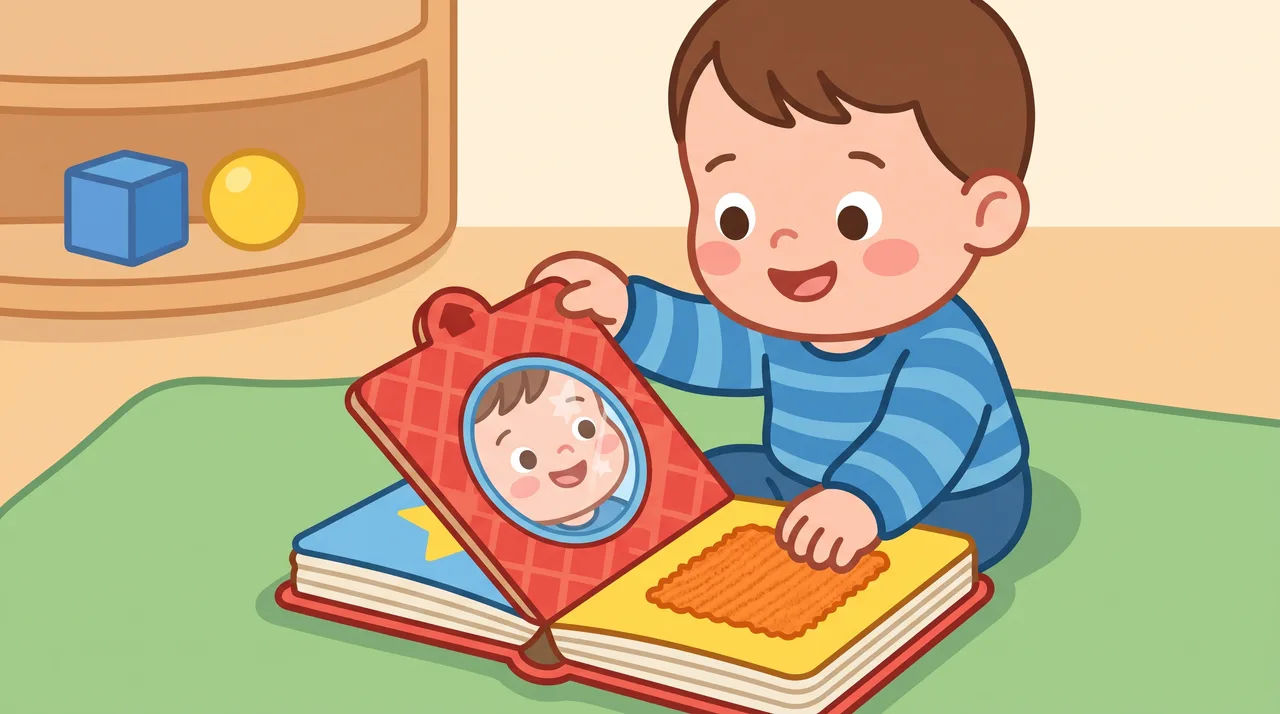
An interactive book for kids is any book that asks the child to do something: lift a flap, complete a task, decide how the story continues, or even find themselves in it as the main hero. The youngest children love touch-and-feel board books and lift-the-flap books, preschoolers enjoy activity books and search-and-find books, and school-age kids go for gamebooks and personalized stories. And because interactivity mostly happens between parent and child, a few good questions can make almost any book interactive.
Four kinds of interactivity: flaps, tasks, choices and personalization
The label "interactive book" covers very different things — from a board book with a sound button to a tablet app. When choosing, it helps to ask what exactly the child will do while reading, because each kind of interactivity builds a different skill and suits a different age:
- Hands-on interactivity: flaps, sliders, sounds and texturesThe child physically moves the book: lifts flaps, pulls tabs, feels textures, presses sound buttons. This is the most common type for children up to about three. The interaction happens in little hands — so choose sturdy board pages and strong flaps that survive a firm grip.
- Activity interactivity: the book asks, the child doesThe book invites the child: shake me, wave, find it in the picture, go outside and look. The classic is Hervé Tullet's Press Here, where you tap colourful dots; other activity books send children to explore nature around the house. A great choice for preschoolers who can't read yet but want to "control" the book.
- Choice-based interactivity: gamebooksAt the end of a chapter the reader chooses how the story continues and turns to the matching page. It needs independent reading, so it works from about age seven. The big advantage: the book can be read again and again with a different ending each time — and a child who "hates reading" will often happily read three endings of the same story, just to see what would have happened.
- Personalization: the child is in the storyThe book is made to order — the main hero has the name and look of a specific child, and siblings or friends can join the story too. The interactivity here isn't mechanical but emotional: the child looks for and recognizes themselves in the story. It works brilliantly for kids who show no interest in ordinary books.
Choosing by age: from touch-and-feel to gamebooks
Treat the age ranges as a guide — the child's reading experience matters more than their birthday. For choosing books in general, see our article Books for kids: how to choose by age, interests and reading stamina.
- 0–2 yearsTouch-and-feel board books, simple flaps, a mirror on the last page. The interaction is pointing and naming things together — what matters more than the book itself is whether you talk with your child over it.
- 3–5 yearsSurprise flaps, search-and-find books, activity books. The child "reads" the pictures — this is exactly the age when the dialogic reading described below works best.
- 6–8 yearsFirst gamebooks with short texts, comics with activities and personalized stories where a beginning reader reads about themselves — a strong motivation for kids who aren't ready for reading yet.
- 9 years and upFull-length gamebooks, fill-in journals, encyclopedias with experiments and observations. The interactivity moves from the book into the activities it sparks — an experiment in the kitchen, a code to crack, a map to follow. Space is a rewarding topic: a book like Professor Astro Cat can be paired the same evening with watching the Moon or the space station passing overhead. At this age children can tell when a task is just decoration, so pick books where the activity really means something.
Dialogic reading: five steps to engage your child with any book
The cheapest interactive book is the one already on your shelf — all it takes is a different way of reading. Dialogic reading is a research-backed method that turns the child from listener into storyteller while the adult just helps. It works with any picture book, including bedtime stories.
- 1Ask an open questionInstead of "Can you see the dog?" try "What's happening here?" or "What do you think he'll do next?". Yes/no questions kill the conversation.
- 2Wait and praise the answerEven a silly one. The goal isn't the right answer, it's getting the child to talk. Count to five in your head — children need more time to put words together than adults do.
- 3Expand on what your child saidAdd a word or two: "Yes, the dog is running — running after the cat into the garden." Your child hears a richer version of their own sentence.
- 4Let your child repeat the longer sentenceA natural "Can you say it like that too?" is enough. Repetition helps new words stick.
- 5Swap rolesWith a familiar book, hand over the storytelling: your child "reads" to you. Campaigns like the Summer Reading Challenge (The Reading Agency) and Read Across America remind parents how much regular reading matters — and dialogic reading gets far more out of every minute.
Printed interactive book or tablet app?
Today "interactive book" often also means apps and e-books with animations. A study in the journal Pediatrics compared how parents and toddlers talked over a printed versus an electronic book: the printed book prompted more conversation about the story, while with the electronic one attention drifted to controls and effects. That doesn't mean screens are always bad — each format just suits something different. A good rule of thumb: do the effects serve the story, or just grab attention?
| Criterion | Printed interactive book | App / e-book with effects |
|---|---|---|
| What the child does | turns pages, lifts flaps, does tasks by hand | taps animations — the device does part of the interaction itself |
| Talking with a parent | happens naturally over the page | interrupted by sounds, animations and fiddling with controls |
| Bedtime routine | a good fit, no screen before sleep | screen light right before sleep is not ideal |
| When it wins | shared reading and the youngest kids | travel, listening to audiobooks, reading away from home |
| Weak spot | flaps and windows can be torn off | effects pull attention away from the story |
How to spot a good activity book or gamebook in the shop
The cover almost always promises interactivity. A quick flick through decides — for a preschool activity book, open three random spreads and ask:
- Can the task be done right there at the book? A good task fits in a sentence or two and the child can do it without preparation: press the dot, find three red things, wave at the page. If it needs scissors, glue and an adult watching, it's not reading, it's a workbook.
- Does the task move the story on? Turn the page and see whether something happened. When the dots tumble down after the book is shaken, the child feels in control. When nothing changes on the next page, it was just a prompt into thin air.
- How many tasks per spread? One or two is enough. A page with five instructions overwhelms a preschooler and the parent starts skipping it.
For a gamebook aimed at early readers, look at three numbers you can check in a minute of flicking:
- Text per page: for a seven-year-old, roughly up to ten lines in large print, ideally with a picture. A solid block filling the page is too much for independent reading.
- Distance between choices: a decision should come every two or three pages. If the child reads ten pages before getting to choose, the gamebook loses its edge.
- Number of endings: check the contents or the last page to make sure there's more than one and that they differ. Books where every path leads to the same ending can't be read a second time.
And one test for every type: hand the book to your child and let them flick through on their own. If they stop and start doing something, it's a good book. If they just turn the pages, the interactivity is only on the cover.
When the child is the hero: what a personalized book can do
A personalized book is a special kind of interactivity: the child doesn't handle the book, they appear in it. At Hero of the Book, the hero is created from a single uploaded photo, the name is woven naturally into the text, and you can add siblings, friends or even a pet to the story.
For reading, this means two things. First, the questions change: instead of "what will that boy do?" you ask "what will you do?" — and your child answers for themselves, not for a stranger. Second, the book can be played out: re-enact scenes at home, add your own sequel and let your child imagine how the next adventure might end. You pick the plot from ready-made worlds, and if the right one isn't there, you describe it in your own words — say, a landing on Mars with a whole crew of siblings.
For bedtime reading, pair it with an audiobook — we explain how to set up an evening routine in our article Bedtime stories.
Sources
- Reading Rockets: Dialogic Reading — An Effective Way to Read Aloud with Young Children — A step-by-step guide to dialogic reading.
- Munzer et al.: Differences in Parent-Toddler Interactions With Electronic Versus Print Books (Pediatrics, 2019) — A study comparing parent–toddler interactions over printed and electronic books.
- Summer Reading Challenge (The Reading Agency) — A UK campaign encouraging children to keep reading over the summer holidays.