
Space Books for Kids: Pick One by the Questions They Ask
8/23/2026
The best space book for kids isn't the one with the most planets — it's the one that answers the question your child just asked. Here's how to spot it.
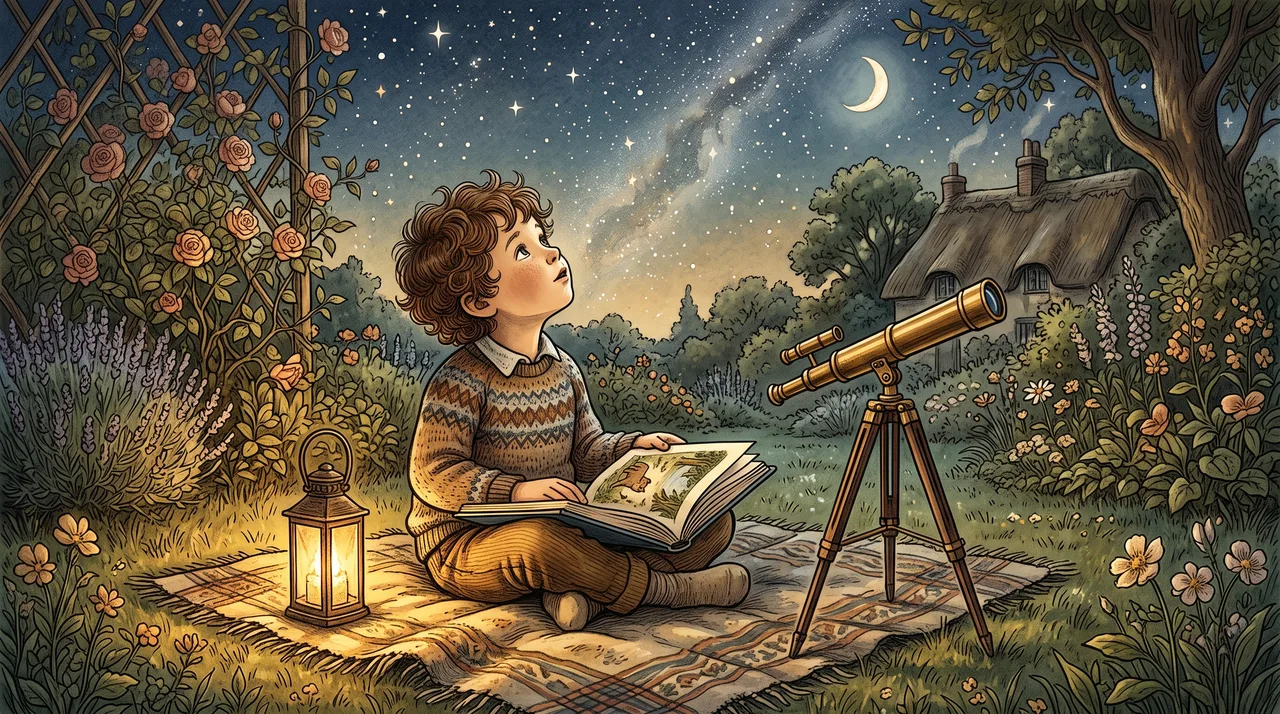
A good space book for kids is one that answers the question your child just asked — why the Moon changes shape, where the Sun goes at night, why we don't fall off a round Earth. For a preschooler, that means big pictures and one idea per spread; a school-age child will appreciate an index where they can look up their own question. An encyclopedia that marches through the planets from the Sun outward is step two: it's a reference book, not an answer, and without a question in mind a child will close it by page three.
Why the order of the planets is a poor place to start
Most space books for kids follow the same outline: the Sun, Mercury, Venus, Earth, Mars, and on outward. That's the logic of an adult who files the universe away like a map. Kids don't come to space through a map, though — they come to it through one specific moment of wonder: in November it's suddenly dark at five in the afternoon, or the Moon looks rounder tonight than it did yesterday.
The difference is easiest to see in what you can actually do with the book in the evening. A chapter about Neptune can be read, but it can't be used: nobody is going to spot Neptune from the bedroom window. A chapter on why the Moon changes shape can be carried to the window and checked — and checked again three days later, because by then the picture in the book matches the sky. A book that offers answers you can verify gets opened a second time.
The practical takeaway for choosing one is simple: before you buy, think of the last question your child asked about the sky and look for it in the index or the table of contents. If it isn't there, the book is answering someone else's questions. It's the same filter that works for every other genre — explained in more detail in our article on choosing children's books by age and reading stamina.
Kids' most common questions about space and what a book needs to do
This table doubles as a list of terms to look up in the index. The ages are a rough guide — they reflect when a question tends to come up most often, not when a child is "ready."
| Your child's question | What the book has to do | When kids ask it most |
|---|---|---|
| Why does the Moon change shape? | Show the lit and unlit halves of the Moon and our view of them in a single picture — a written description of the phases isn't enough | Ages 4–7 |
| Where does the Sun go in the evening? | Explain that Earth spins on its axis, not just state that the Sun set below the horizon | Ages 4–6 |
| Why don't we fall off a round Earth? | Show gravity as a pull toward the center of a ball, ideally with an experiment or a model, not a formula | Ages 5–8 |
| Why do stars twinkle and planets don't? | Teach how to tell a star from a planet in the real sky over your backyard, not in a Hubble photo | Ages 7–10 |
| Is Pluto a planet? | Admit that the answer changed in 2006 and explain why astronomers agreed on a new definition | Ages 7–11 |
| Where does space end? | Not be afraid to say "we don't know yet" and separate what has been measured from what is an estimate | Ages 8–12 |
What to look for in a book at each age
- Ages 3–5: one idea per spreadSturdy pages, big areas of color, very little text. Each spread should carry a single idea — day and night, the Sun and the Moon, the stars. A sentence like "Earth orbits the Sun along an elliptical path" has no place in this book; a preschooler needs a picture you can point to and one sentence to go with it.
- Ages 5–7: the question as the headingThe ideal book uses the question itself as the heading, with an answer that fits on one page. Kids this age can't yet read fluently on their own, but they can flip through a book and hunt for a picture they remember. Size comparisons (Earth next to the Sun) are a big plus — abstract numbers don't mean anything yet, but a ratio in a picture does.
- Ages 7–9: an index, experiments and the real skyThis is where space either sticks as a hobby or doesn't. Look for a book with an index, simple kitchen-table experiments (a flashlight and a ball for the Moon's phases, weighing things, a solar system made of fruit) and a clear star map for the current season. A book that sends your child outside and keeps them coming back beats a picture book ten times prettier.
- Ages 9–12: numbers, scale and the limits of what we knowAn older child can handle distances in light-years and takes seriously the things we still don't know — black holes, exoplanets, life elsewhere. At the same time, keep an eye on reading stamina: a long encyclopedia often just gets flipped through. Specific picks based on how many pages a child will really read are in our article on books for kids ages 8–10.
A five-minute test you can do right in the bookstore
- 1Find your child's question in the indexNot the table of contents — the index. Try "Moon," "phases," "gravity" or whatever your child asked about last. If the book has no index and the topic isn't in the contents either, keep looking.
- 2Read one paragraph out loudQuietly, the way you would at bedtime. If you trip over a long sentence or have to stop mid-sentence to explain another term, the text was written by an adult who only thinks they're writing for kids.
- 3Check what the book says about PlutoIt's the fastest test of how current a book is. If Pluto is listed as the ninth planet with no note, the book (or its edition) predates 2006, and that's probably not the only thing in it that's out of date.
- 4See whether the pictures are honestTelescope photos are beautiful, but a child can't learn much from them. Look for at least one diagram that shows how something works — why eclipses happen, why the Moon has phases, how big Earth is next to the Sun.
- 5Find out whether the book gets your child away from the tableAn experiment, a star map, a tip like "tonight, look to the south." One page like that does more for a child's interest than thirty pages describing planets.
Answers to borrow when your child asks before the book arrives
These are short on purpose — a child needs an answer about as long as the question. If they want more, they'll ask.
What a space book can't do on its own
Space is one topic where a book alone isn't enough, because the real thing is free and right over your head. The cheapest add-on is a blanket in the backyard after dark and fifteen minutes of quiet; the second cheapest is a sky-map app on your phone that tells you what you're looking at. Observatories and planetariums often run programs split by age, and for a preschooler a show aimed at older kids tends to be a letdown, so it's worth checking the schedule before you buy tickets.
The other route is story. An encyclopedia answers but doesn't draw you in; a bedtime tale about a trip to space draws you in but doesn't answer. They work best side by side — and for kids who can't read on their own yet, reading aloud in the evening is often the only way the facts get in at all. How to turn that into a ritual that lasts is covered in our article on bedtime stories.
A personalized book belongs in that second category too: at Hero of the Book, we create a story where your child is the main character, so they're the one who gets to fly into space. You pick the plot and the illustration style, the book has 12 illustrated spreads, and the e-book is usually ready in about 15 minutes. It won't replace a nonfiction book — think of it as the hook that gets the questions rolling.
Sources
- NASA Space Place — Explainers on astronomy written for kids and parents — Moon phases, gravity, the solar system.
- ESA Kids (European Space Agency) — ESA's section for kids: space, Earth and life in orbit, available in several European languages.
- International Astronomical Union (IAU) — The organization that adopted the definition of a planet in 2006 and reclassified Pluto as a dwarf planet.