
Gifts for a Newborn: Three Piles and What Goes Where
9/17/2026 · The Hero of the Book Team
Newborn gifts fall into three piles: for the baby, for the parents, and keepsakes. How to choose from each and avoid buying the same thing twice.
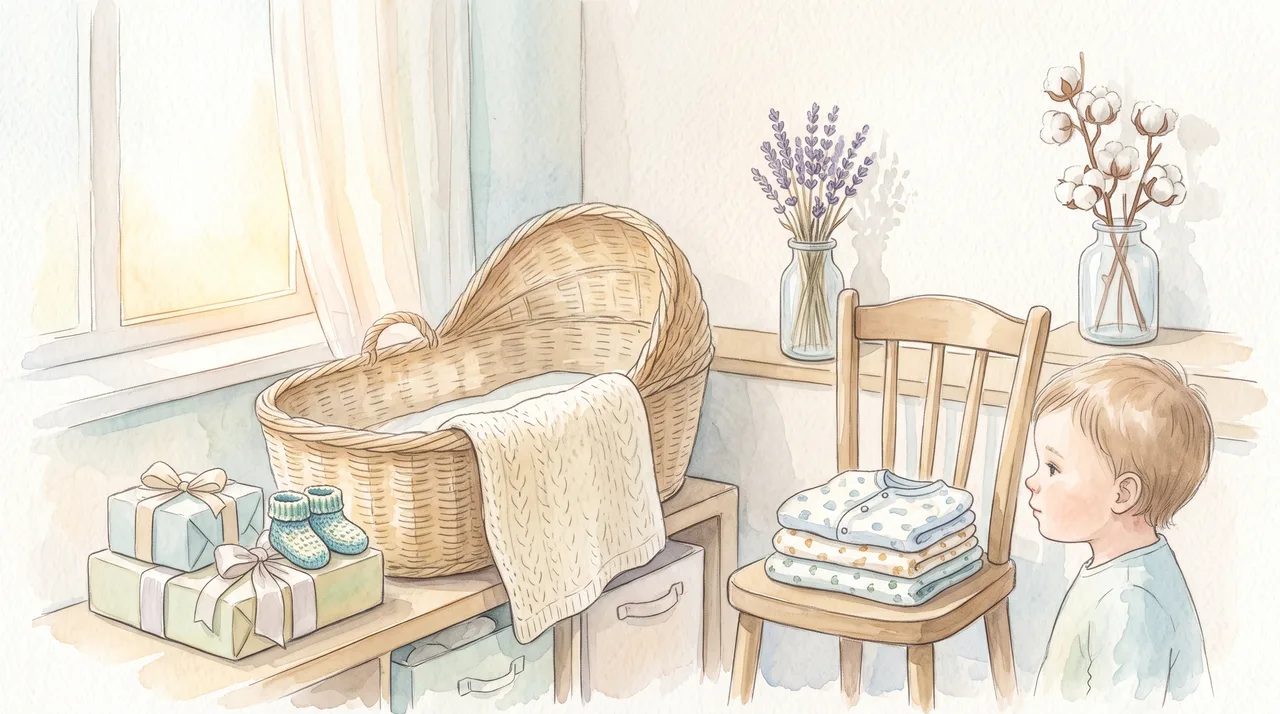
Gifts for a newborn fall into three piles: things the baby actually uses (clothes in bigger sizes, diapers, a sleep sack), things that really go to the parents (meals, cleaning, an extra hour of sleep), and keepsakes that hold up even though the newborn doesn't notice them at all. The most common mistake isn't a bad gift, but three identical ones: a play mat from Grandma, from an aunt and from coworkers. Before you start choosing, ask what the family already has and what they got as hand-me-downs from a friend.
If you know nothing at all, go two sizes up from where the baby is now and add something to eat. Both get used up, and there's never too much of either.
Finding your way through newborn gifts
This article is a map. Each pile has its own rules, and separate articles cover the individual types of gifts.
The three piles side by side: who actually uses the gift
Before you buy a gift, put it into one of the three piles. Most disappointments happen because the giver aimed at one pile and hit another.
| Pile | Typical gift | When to choose it | Where it goes wrong |
|---|---|---|---|
| Used by the baby | Clothes in bigger sizes, a sleep sack, diapers, creams | You know the due date and the season the baby will grow into | Newborn sizes and seasonal pieces for right now: parents already have a dresser full of those |
| Used by the parents | Meals, delivery, watching an older sibling, a coupon with a date | The first six weeks, families on their second or third child, twins | A coupon with no date. An offer of “let me know if you need anything” almost never gets used |
| Kept as a keepsake | Prints, jewelry with a date, a letter to the future, a book with the child's name | You're close to the family and want something of you to stay around even ten years from now | A keepsake an exhausted parent has to finish: it stays half-done |
What the baby actually uses (and what stays in the closet)
A newborn needs surprisingly few things and goes through a lot of them. That's exactly why it makes sense to buy ahead and size up.
- Clothes two sizes upParents get the smallest sizes from the hospital and from friends, and babies outgrow them the fastest. Buy two sizes up and think about what season it will be when the baby grows into them: a summer tank top for a winter baby makes a cute photo and nothing more.
- A sleep sack instead of a blanketThe UK's NHS and the American Academy of Pediatrics both recommend keeping anything that could cover the baby's face out of the crib: no pillows, comforters, bumpers, loose blankets, stuffed animals or “nests.” A sleep sack meets that rule; a fancy bedding set with a bumper doesn't.
- Consumables that run outDiapers (not the smallest size; parents have a stash of those), wipes, baby laundry detergent, diaper rash cream. It doesn't sound like a gift, but it runs out at the worst possible moment and never clutters up the house.
- One toy for later, not five for nowFor the first weeks, a newborn can't see clearly at a distance, and the most they'll get out of toys is a high-contrast black-and-white picture above the changing table. Rattles, a play mat and a crib mobile are useful from about three months on, and that's exactly the kind of thing two other people will buy too.
Gifts that really go to the parents
In the first weeks, the scarce resources are time and food, not another object. This pile is usually the least flashy and the one parents remember most.
- Food you can eat with one handHome-cooked portions for the freezer, soup in a sealable container, something you can eat standing at the kitchen counter. Ask ahead about allergies, and whether Mom is breastfeeding and avoiding anything.
- A coupon with a specific dateAlmost nobody takes up “let me know if you need anything,” because it means extra work: figuring out what to ask for, and then asking. Write it out instead: I'll come Tuesday at nine, walk the dog, do the ironing and leave.
- An hour of sleepOffer to take the stroller for a walk and come back in two hours. For parents of a second child, it's the most valuable gift there is.
- Something for an older siblingA home that already has one child gets ten gifts for the baby and zero for the three-year-old who just lost half the attention. A little something for them is a gift to the whole family, and in all the rush, parents usually don't have the headspace for it.
Keepsake gifts: what's really left after a year
The third pile is the only one that makes sense even when the child won't notice it for years. You'll recognize it by a simple test: is it worth having even if it doesn't get used at all this year? A footprint, jewelry with a date, a letter in a sealed envelope or a book with the child's name doesn't get in anyone's way at home, and ten years from now these are the only things from that whole pile that still exist.
Two things can ruin a keepsake even with the best intentions. The first is unfinished work: a print kit that an exhausted parent has to make at 3 a.m. stays in its box. More on that in our article on how to make and preserve hand and footprints. The second is a botched inscription: an engraving with a typo in the name or the wrong date can't be fixed, and that's exactly why jewelry with a name and date has its own article.
A book where the child is the hero also belongs among keepsakes. With a newborn, it's only fair to say how that works: the baby gets nothing out of it at first and spends the first years just chewing on it. It makes sense either as something that waits for the child on the bookshelf, or, usually the smarter choice, as a gift for an older sibling that adds a new character, the baby: the three-year-old brother gets something of his own at a moment when everything else belongs to the newborn. At Hero of the Book, the illustration is created from a single uploaded photo, so the hero looks like that particular child, the name is woven naturally into the text, and it's a one-time purchase, no subscription.
And a warning that belongs in this pile: with a name book, double-check how the name is spelled first. Katelyn, Caitlin, Matthew, Mathew: the name runs through the whole story and the dedication, so you'd read the typo again every single time. Also think about who the book is for: givers often enter the newborn's name, even though it's the older sibling who actually opens the book. And keep in mind that before you pay, you'll see a suggested title, a story preview and the dedication, but not the finished illustrations; those are created from the uploaded photo afterward. If you're writing a dedication in the book, it pays to think it through; what to write in a dedication gets its own chapter.
How to coordinate so you don't end up with three identical play mats
Duplicate gifts don't come from stinginess or lack of interest; they come from being too shy to ask. Here are the steps that sort it out in one evening.
- 1Ask the parents, not the other gift-giversThe only people who know what's already at home are the parents. “Is there anything you still need?” is extra work for them; it's better to offer two specific things and let them pick.
- 2Set up one place where everyone can see who's getting whatA shared note or a group chat is enough. What matters is that people write in it before they shop, not after.
- 3Split the piles among yourselvesMake sure each of the three piles has someone: grandparents usually handle the baby pile, coworkers the parents pile, and the closest friend the keepsake. Three identical gifts happen when everyone aims for the first pile.
- 4Agree on sizes and seasonsIf two people are buying clothes, have each one pick a different size. Without that one sentence, both will buy the same size, because they both looked at the same prettiest shelf.
- 5Keep the receipt and say so out loud“If it turns out to be a duplicate, feel free to exchange it; the receipt is in the envelope.” Parents won't bring it up themselves: exchanging a gift comes with a feeling of ingratitude, and that one sentence takes it off their shoulders.
Messages for the family group chat you can copy
The hardest part of coordinating gifts is the first message. These are written so they don't boss anyone around and can be sent as is.
Gifts that look great but don't belong in the crib
Some newborn gifts sell precisely because they look nice in photos. The UK's NHS recommends keeping the crib empty: no pillows, comforters, bumpers, loose blankets, stuffed animals, or so-called nests or positioners meant to hold the baby in place. The American Academy of Pediatrics gives the same advice in its safe sleep guide. So a decorative bedding set with a bumper or a big stuffed animal for the crib isn't a gift for the baby, it's decor for the adults.
With toys, check two things. The “Not suitable for children under 36 months” label (a crossed-out baby face in a circle) isn't an age recommendation but a warning about small parts that can be swallowed, and it applies even when the toy sits in the crib “just for decoration” and an older sibling picks it up. The second thing is origin: EU toy safety rules are based on the Toy Safety Directive and the CE marking, but for products from marketplaces outside the EU, nobody guarantees the marking reflects reality. Specific recalled products can be looked up in the EU rapid alert system, Safety Gate.
The last category isn't dangerous, just pointless: perfumes and cosmetics for newborns, ten-piece clothing sets all in one size, giant stuffed animals over three feet tall, and anything that needs batteries and plays a tune. A detailed list, including why people buy these things, is in our article on what to avoid with a little one.
Sources
- NHS: Sudden infant death syndrome (SIDS) — Safe sleep recommendations: what doesn't belong in the crib (pillows, comforters, bumpers, loose blankets, stuffed animals, nests).
- American Academy of Pediatrics: A Parent's Guide to Safe Sleep — A guide to safe infant sleep from the American Academy of Pediatrics.
- European Commission: Toys (toy safety) — EU toy safety rules, Directive 2009/48/EC and harmonized standards.
- Safety Gate: the EU rapid alert system — A database of dangerous non-food products withdrawn from the EU market, where you can look up a specific toy or children's product.