
Help After Birth: Meals, Cleaning and Childcare to Offer
10/17/2026
What really eases the load for new parents, and how to offer help they won't turn down just to be polite. With messages you can copy.
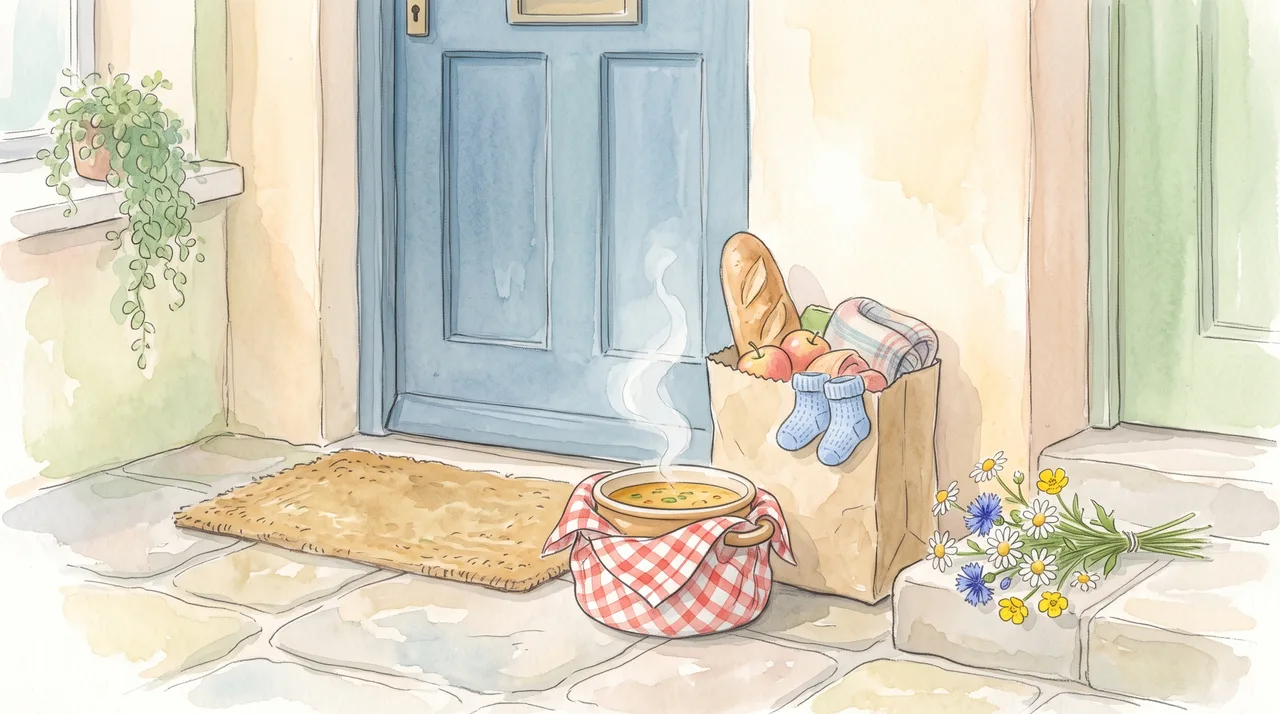
What helps most after a birth is the stuff that has to happen at home every day: a hot meal, groceries, cleaning, laundry, and looking after an older sibling. To make help easy to accept, offer it specifically — what, when and for how long —, deliver it without a required visit, and let the parents say no without explaining. “Let me know if you need anything” almost never leads anyone anywhere.
Why “let me know if you need anything” doesn't work
A general offer leaves all the work to the parents. They have to figure out what they need, guess whether it's okay to ask you for it, and on top of that admit they aren't coping. In the first weeks after birth, when sleep comes in scraps, even that is one more decision.
A specific offer takes that work off their plate: all they have to say is yes, no or another time. “On Thursday I'll drop off a pot of stew that'll last two days and leave it by the door” is a gift. “Let me know if you need anything” is a chore.
Timing matters too. Plenty of people offer in the first week, when the other parent is often home and there are more than enough visitors. Once the partner goes back to work, Mom is often alone with the baby during the day. That's why the most valuable help tends to come in weeks three to eight, when nobody is checking in anymore.
Meals, groceries, cleaning, childcare: what exactly to offer
| Help | What to offer | How to deliver it | What to avoid |
|---|---|---|---|
| Meals | A ready meal for 2–3 days, soup, something you can eat with one hand (muffins, cut-up fruit, oatmeal energy bites) | In disposable containers or labeled with your name; leave it by the door or hand it over at the door | Asking “what do you like?” without giving options; cooking without knowing about allergies or whether Mom is breastfeeding and avoiding anything |
| Groceries | A big shop from their list, or a regular one: “I go to the store every Tuesday, text me by Monday” | Put it away in the fridge, text a photo of the receipt, sort out the money later with a transfer | Buying what you think they need and then waiting at the door to be paid |
| Cleaning and laundry | Two hours of cleaning, washing and folding laundry, doing the dishes, taking out the trash, walking the dog | Agree on when you'll arrive and when you'll leave; clean, don't chat | Commenting on the state of the house; rearranging things your way |
| Watching an older sibling | An afternoon outside, daycare pickup, a weekend morning at your place | Set a fixed time and a place to hand off the child | Offering to hold the baby — parents usually don't need someone else holding the baby, they need a chance to sleep |
| Errands | Post office, pharmacy, returning packages, a ride to the hospital for a checkup | Take the task along with the paperwork and bring it back done | Calling about every little thing — ask once, then act |
Help without a visit: how to deliver it
The most common reason parents turn help down isn't pride, it's the visit that comes with it. Whoever brings soup has to be invited in, offered coffee and shown the baby. For an exhausted mom, that can mean an hour she wanted to spend asleep.
So offer a way of delivering it that asks nothing of them: the meal by the door and a text saying “it's outside,” groceries put away in the fridge without lingering, an older child looked after at your place. If you do come in, say up front how long you'll stay and stick to it. When to visit and how long to stay once you're invited is covered in Visiting After a Baby Is Born: When to Go, How Long to Stay and What to Bring.
And the help doesn't have to come from you alone. If more people want to pitch in — coworkers, family, friends —, bring them together and split up the days in a shared spreadsheet. That way the parents don't end up with four lasagnas on Monday and nothing for the whole next week.
How to organize a meal train
- 1Ask once, and ask wellOne message to the parents: allergies, what they don't eat, whether Mom is breastfeeding and avoiding anything, how many people are eating and where to leave the food. That covers all your questions in one go.
- 2Set up a shared spreadsheet or group chatRow = day, column = who's cooking and what. The parents never need to look at it — it's for the helpers, so meals don't repeat and nobody forgets.
- 3Spread it over three to six weeksEvery other day is enough, with portions for two days. A longer meal train with gaps helps more than one week when the fridge won't close.
- 4Agree on one drop-off ruleFor example: food by the door before 5 p.m., a message in the group, no dishes to return. That way the parents don't have to open the door for anyone or keep track of anything.
- 5After three weeks, ask whether to keep goingSome will be glad of another round, others will want to cook for themselves again. Whatever the answer, it's the parents' call.
Messages to copy: an offer they can accept
How to offer help without it feeling like an inspection
Help that arrives with advice soon stops being accepted. Anyone who brings an opinion on breastfeeding, pacifiers or the baby sleeping in a crib along with the groceries leaves as a guest who added work. Stick to what you offered: you came to do the laundry, not to judge.
Just as important is leaving room for a no. “Feel free to just text no” sounds like a courtesy, but it makes a big difference — the parents don't have to come up with an excuse. If they turn the offer down, don't take it personally, and a week later offer again in a different form.
And pay attention to how Mom is doing. According to Britain's National Health Service (NHS), sadness, tearfulness and irritability in the first days after birth are common and usually pass within two weeks. If they last longer or get worse, it's a good idea for her to talk to a doctor. Dads can have postpartum depression too. It's not your job to diagnose — but regular contact over groceries is often the moment someone notices first.
Help as a baby gift
If you don't know what to buy for the baby, you can give time instead. A coupon for “three dinners in February” or “two Saturdays with Annie” means more than a tenth onesie, as long as the giver actually follows through. Write a specific date on it, or at least how to arrange it, so the parents don't have to remind you.
A gift like that pairs well with a little something for Mom: ideas for easing the first six weeks after birth are in Gifts for Mom After Birth, and how to put together a basket of things that actually get used is shown in A Postpartum Gift Basket for Mom. Who you're really giving the gift to — the baby, the parents, or an older sibling — is something you can sort out in A Gift for a New Baby: Who Is It Really For?.
The older sibling is easy to forget after a birth, yet they're the one losing the most attention. If you take them out for an afternoon, add something that belongs to them alone: an outing they picked, baking together, or a book where they're the main character — maybe about becoming a big brother or big sister. A personalized digital book is usually ready in 15 minutes, so it works even at the last minute. You'll be helping the parents twice over: the child is happy and the house is quiet for a while.