
Walking to School: Reflectors, Route Practice, Going Solo
10/15/2026
A calm walk to school: where reflectors belong, how to practice the route step by step, and how to tell your child is ready to walk alone.
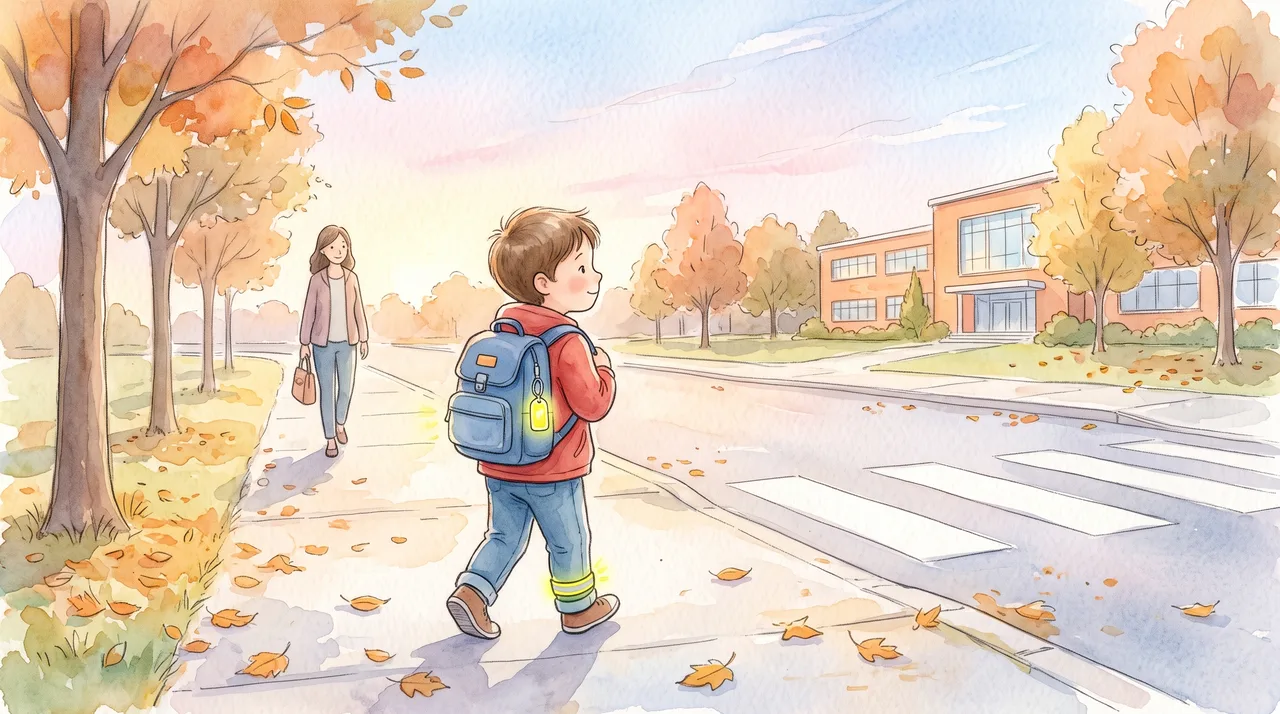
A safe walk to school rests on three things: your child is visible (reflectors on the side facing traffic, at headlight height), knows one fixed route you have walked together many times, and knows what to do when something goes wrong. Rules about children walking or biking on their own are set by each state and sometimes by local ordinance, so check what applies where you live. Beyond that, the real signal is this: your child can lead you along the route several times in a row without a single mistake, while you simply follow and stay quiet.
When to let your child walk to school alone
What the rules say about children out on their own varies from state to state, so look up the ones where you live. In everyday practice, the decision is the parent's, and so is the responsibility. Schools and after-school programs usually want to know in writing whether a child leaves on their own or gets picked up, so ask what exactly they need from you.
That is why age is a poor yardstick. It works better to ask about specific skills: Does your child stop at the crosswalk on their own, even in the middle of telling a story? Do they look left, right and left again, or just turn their head? Do they know what to do when the walk signal is on but a car keeps coming anyway? Can they say no to a stranger who offers a ride, even a friendly one?
A realistic look at the route helps too. Five minutes along a quiet street with a sidewalk is something a first grader can handle much sooner than twenty minutes that include crossing a four-lane road with no traffic light. Younger kids are worse at judging how fast a car is approaching, and a friend across the street can easily distract them. So start with a short stretch and add independence bit by bit, not all at once from the first day of school.
Reflective gear for the walk to school: what and where
| Item | Where to put it | What to watch for |
|---|---|---|
| Reflective slap band | On the wrist or ankle on the side facing traffic | The ankle shows up best: it moves and sits at low-beam height |
| Backpack reflector tag | On the bottom of the backpack, not the top handle | Hanging high and behind the back, a driver can't see it from the front |
| Built-in reflectors on the backpack | Check the back and the sides | Often they are only on the back and missing on the sides, where your child crosses |
| Reflective vest | Over the jacket, especially where there is no sidewalk or lighting | A vest under an open jacket or stuffed in the backpack does nothing |
| Jacket or shoes with reflective strips | Strips on the sleeves and heels | They fade after a few washes, so test them with a flashlight once a season |
| Light-colored clothing | Overall | Helps at dusk, but cannot replace a reflector in the dark |
Why reflectors belong on the traffic side
Reflective material does not glow on its own; it bounces light back toward its source, which is the driver. So it only works where headlights reach: low down and on the side of the body. A tag tucked behind the back or high on a shoulder looks cute, but a driver coming toward your child barely sees it. A driver notices a pedestrian in dark clothing only a few dozen yards away, while reflectors make them visible from many times that distance.
Whether reflective gear is required for pedestrians, and where, depends on local rules. Either way, from November through February many kids walk to school at dawn or in the dark, and the difference in visibility is the same everywhere. The simplest rule for a child: a reflector is like a hat. In winter, you don't leave the house without it.
Try it together: one evening, shine a flashlight on the backpack and jacket from a distance. Whatever lights up is working. Whatever stays dark needs to be added or moved.
How to practice the route to school step by step
- 1Pick one route, not the shortest oneThe safest way is usually the one with a signalized crosswalk or a crossing guard, even if it takes a few minutes longer. Your child should always go the same way and only try shortcuts once you say so.
- 2Walk it at the time kids actually goAt seven in the morning a street looks nothing like it does on a Saturday afternoon: cars backing up near the school, a garbage truck, delivery vans parked by the crosswalk. Practice in real traffic.
- 3Name landmarks togetherThe bakery, the yellow house, the fountain. Kids don't remember street names, but they do remember "turn left at the fountain." Use the same landmarks yourself when you ask where something happened.
- 4You lead, your child narratesFor a few days you walk first and your child says out loud what you are doing and why: "We're stopping here because that car is backing up." Saying it sticks better than hearing it.
- 5Your child leads, you stay quietNow switch roles. Your child decides when to cross while you walk a step behind and don't step in unless there is real danger. Talk through any mistakes at home, not on the sidewalk.
- 6Follow from a distanceWalk twenty yards behind, or on the other side of the street. Once your child leads you along the route several times in a row without a mistake, they are ready for the first solo walk.
- 7First solo walks: a short stretchStart with the last bit: walk your child to the corner where the school comes into view. Extend the solo stretch only once they handle the previous one with confidence.
Danger spots adults tend to overlook
- Parked cars near the crosswalkAn adult can see over them, a child can't, and the driver can't see the child. Teach your child to stop at the edge of the parked car and look from there.
- Driveways and alley entrancesA sidewalk across a driveway still looks like a sidewalk, but cars back out of it, and the driver is watching the street, not the sidewalk.
- The school drop-off zoneParents stopping "just for a second," U-turns in the street, car doors swinging open onto the sidewalk. Ironically, the riskiest spot on the whole route.
- City bus stopsCrossing right in front of or just behind a stopped city bus is dangerous, because your child and oncoming drivers can't see each other. Have them wait until the bus pulls away.
- The walk signalA walk signal doesn't mean a car will stop. Turning drivers are supposed to yield to pedestrians, but your child needs to make sure the driver has really seen them.
Family rules your child will remember
Phone, smartwatch, bike and bus
Being able to reach you mostly calms you down; it doesn't replace your child's independence. A phone in hand at the crosswalk is more of a risk, so agree that it only comes out in an emergency. Kids' smartwatches with calling have the advantage that a child doesn't treat them like a screen full of games; what to look out for is covered in Kids' watches: a gift that teaches responsibility.
On a bike or scooter, different rules apply than for pedestrians. When a child may ride in the street alone, whether a helmet is required and whether riding on the sidewalk is allowed are all set by state law and local ordinances, and they differ from place to place, so check them before your child heads out. For a first grader, riding to school in the street alone is usually not a good idea; on the sidewalk, ride only where it's allowed and always give way to people walking.
Practice a city bus ride the same way as the walk: where to get on, how many stops to ride, when to signal for a stop and what to do if your child misses their stop. The answer should always be the same: get off at the next one and call.
Starting first grade is a big change for a child even without walking to school alone. What helps new first graders cope with their worries is in A gift for a first grader: based on what they fear and look forward to. Some kids get used to a new situation best through a story they star in themselves: in a personalized book, the hero looks like your child from their photo and carries their name.
Sources
- Your state's traffic laws and driver's manual (current version from the state department of motor vehicles or transportation) — rules for pedestrians and for children on bikes
- Local city or county ordinances — sidewalk riding, helmet requirements and school-zone rules