
Kids' Watches: A Gift That Comes with Responsibility
10/11/2026 · The Hero of the Book Team
Analog, digital, or GPS? How to choose a watch by age, and why an alarm clock, a house key and a wallet belong in the same family of gifts.
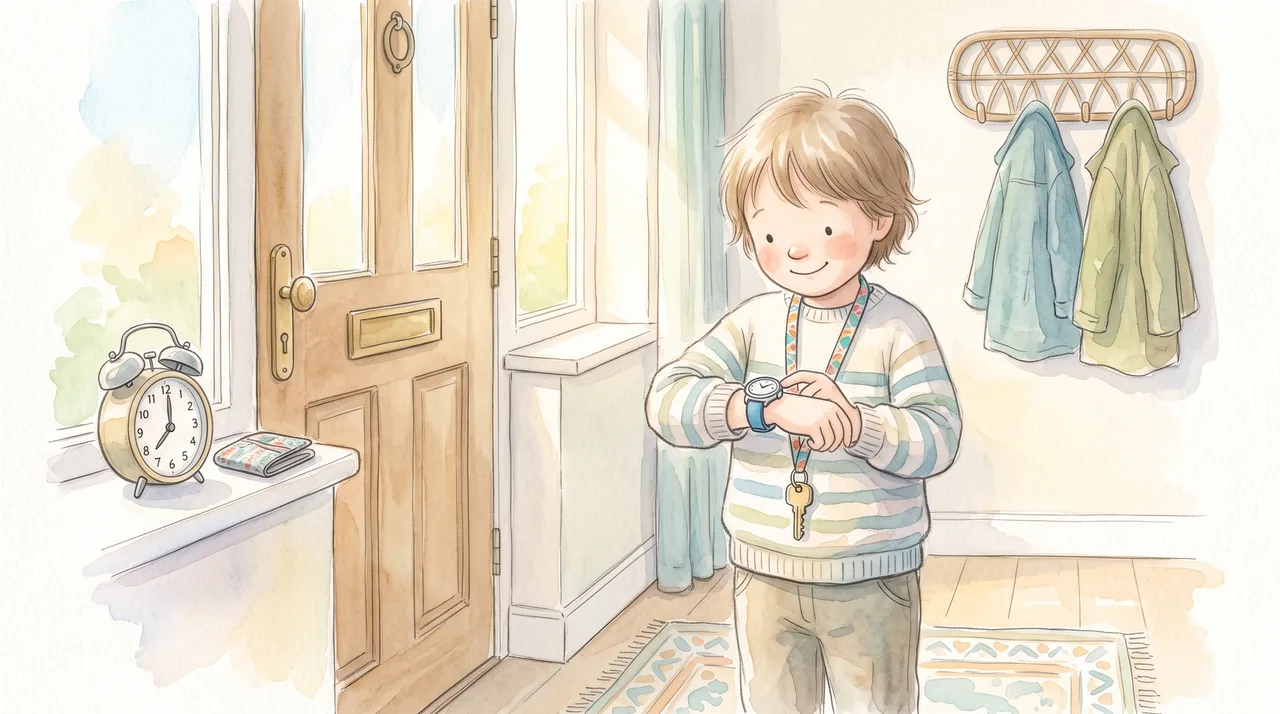
For a child who's still learning to tell time (roughly ages 6–8), the best choice is an analog watch with a clear, easy-to-read face and numbers — no apps, no internet. Add a digital one once they can read the hands without counting, and treat a GPS smartwatch as a phone on the wrist, not a toy. The gift works when it comes with a job: from now on, they keep track of time themselves.
When a child is ready for a first watch
What matters isn't age but whether your child actually needs time for something. Under the Common Core math standards, US kids learn to tell time on analog and digital clocks in first and second grade, so a first grader is already learning it at school — and a watch on the wrist gives them practice every day.
A good sign is when your child starts asking "what time is it?" or "how long until…?" on their own. For a preschooler who can't read a clock yet, a watch is just a bracelet — a sand timer or a light-up "okay to wake" clock that shows when it's time to get up works better.
In practice it looks like this: ages 5–6 an alarm clock or a light-up clock, ages 6–8 a first analog watch, ages 8–10 a digital or combo watch with a stopwatch and alarm, 10 and up maybe a smartwatch, if your family has a reason for one. For more ideas for a child about to start school, see Gifts for a First Grader.
Analog, digital, or smartwatch
| Analog | Digital | GPS smartwatch | |
|---|---|---|---|
| What it teaches | reading time, estimating how much is left | exact time, stopwatch, alarm | mostly staying in touch with parents |
| Best age | 6–8 | 8–10 | 10 and up, depending on family needs |
| What to look for | numbers 1–12, minute markings, glow-in-the-dark hands | large display, simple buttons | app security, SIM, approved contacts list |
| Weak spot | without practice, it's just decoration | knows the time to the minute but not how much is left | charging, fees, privacy, distraction |
| The responsibility it carries | I keep track of my own time | I wake up and time things myself | I'm reachable — but my parent sees everything |
GPS smartwatches: what to watch out for
A smartwatch with location tracking is really a small phone. In 2017, the Norwegian Consumer Council had several models tested by a security firm and found serious flaws: a stranger could take control of the watch, track the child's location, listen in and talk to them. Alerts that the child had left a safe zone weren't reliable either.
That leaves three things to check before you wrap one up. First, who's behind the app and whether the manufacturer releases updates. Second, whether you can set an approved contacts list so not just anyone can call the watch. Third, what the SIM plan and charging look like — a watch that's dead by noon won't teach responsibility.
And one more question that's easy to miss with a gift: do you want to give your child responsibility, or give yourself peace of mind? A watch that lets a parent track location constantly mostly teaches that someone else is in charge. If you're getting one for safety on the way to school, agree with your child ahead of time on when you'll check their location and when you won't. Also find out whether their school even allows them during class.
Alarm clock, key and wallet: gifts from the same family
- Their own alarm clockGreat even for a preschooler. A child who wakes up on their own doesn't need to be dragged out of bed every morning. Choose one with a classic clock face — they'll practice telling time before they ever get a watch.
- A house keyA key on a colorful lanyard or a name key ring tells a schoolkid "we trust you now." Hand it over only once your child really does unlock the door alone, and practice what to do if it gets lost — where to go and whom to call.
- A wallet with a first allowanceA wallet with no money in it is just a pouch. Pair it with a regular allowance and a clear rule about what your child pays for on their own. How to give money so some of it actually lasts is covered in How to Give Money — the principle works for a ten-year-old too.
- An engraved watchA name and a date fit on the back of the case. An engraving like that turns an everyday item into a keepsake; for ideas on what to engrave so it won't feel cheesy in ten years, see jewelry with a name.
How to give a watch so your child actually wears it
- 1Choose the watch together with a jobBefore you buy, decide what your child will use it for: leaving for school, coming in from playing outside, getting to practice on time. One specific job is enough.
- 2Check the face and the strapThe numbers should be readable at a glance, and a hook-and-loop strap is one your child can fasten alone. A metal buckle with holes frustrates most first graders.
- 3Read the water resistance ratingA rating of 3 ATM or 30 m means splash-resistant, not swim-proof. If your child takes swim lessons, look for at least 5 ATM, or take the watch off before the pool.
- 4Give it with a sentence, not just a boxSay out loud what's changing: "Starting tomorrow, you keep track of when you need to be home." A gift that comes with a rule is one your child will remember as a step toward independence.
- 5Check together the first week, then let goFor a few days, ask "what time is it, and how much time do you have left?" Then stop reminding — otherwise the watch stays decoration and you're still the one keeping track of time.
When your child won't wear the watch or loses it
A watch in a drawer is the most common way this gift ends. Usually it isn't laziness — it's that your child doesn't need the watch for anything, because a grown-up is still keeping track of time. Go back to the job the watch came with: once your child has to know when to leave the playground on their own, they'll start glancing at their wrist.
The second reason is comfort. A heavy case, a pinching strap or a watch that ticks by the bed at night gets put away. Swapping the strap for a fabric hook-and-loop one solves most complaints.
And if the watch gets lost or broken? That's part of responsibility just as much as wearing it. For a first watch, an inexpensive model makes sense — your child should be learning to keep track of time, not worrying about an expensive item. Agree together whether the next watch comes out of their allowance or as a birthday gift. Both teach that things have value, just at different speeds.
Engravings and card messages to copy
Pair the watch with a story about a hero who masters time
For little kids, responsibility is easier to “wear” inside a story. When your child gets a watch along with a book in which they're the hero handling a task on time, the new rule comes with a picture to go with it. At Hero of the Book you can create a personalized book featuring your child's likeness from a single photo; the digital version costs $7.99 and is usually ready within 15 minutes — so it works even as a last-minute gift. You can add your own dedication to the book; for ideas, see Book Inscriptions.
Sources
- Forbrukerrådet (Norwegian Consumer Council): Significant security flaws in smartwatches for children (2017) — Test of children's smartwatches — remote takeover, location tracking, eavesdropping.
- Common Core State Standards: Grade 1 Measurement & Data — First-grade math — telling and writing time in hours and half-hours using analog and digital clocks.