
Pretend Play: Costumes and Props for More Than One Story
10/16/2026
A scarf, a hat, a box and a notebook carry dozens of games. What goes in the dress-up box, how to run a flower shop, and lines that get play going.
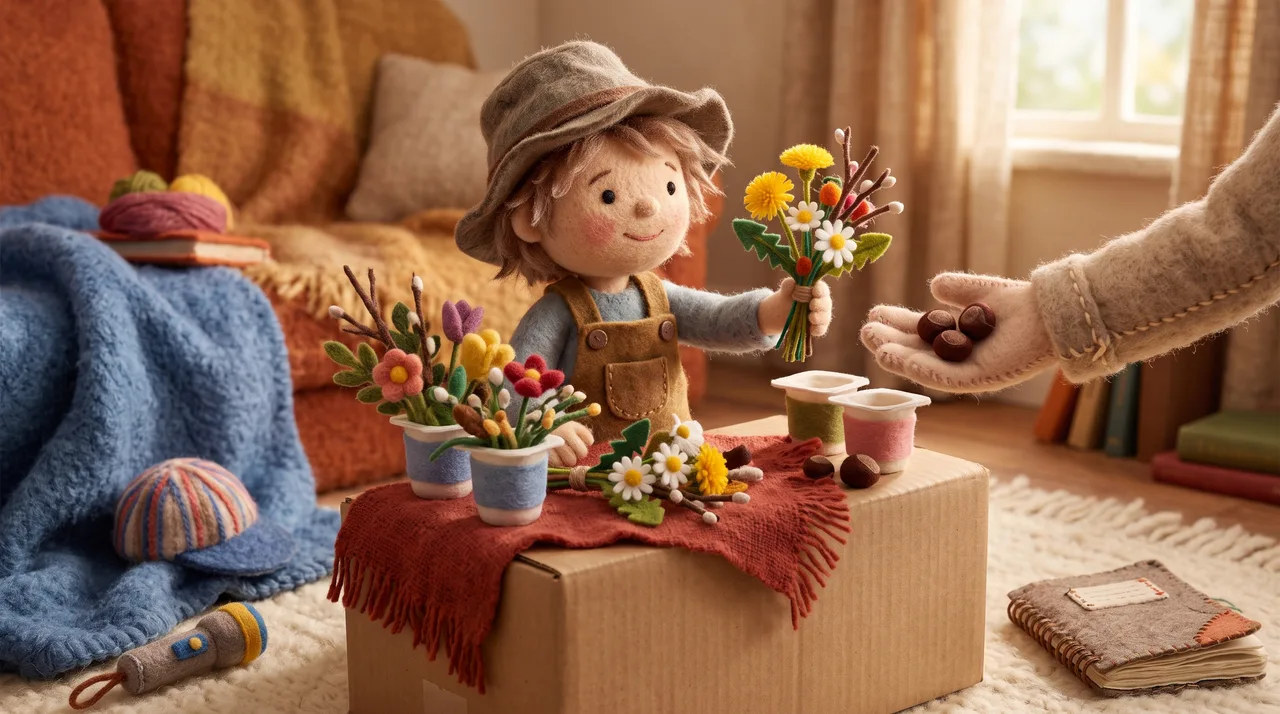
Pretend play is a game in which a child spends a while being someone else — a cashier, a doctor, a mail carrier or a dragon. What keeps it going longest are props that don't belong to one character: a big scarf, a box, a hat, an apron, and a notebook with a pencil. A ready-made princess costume carries one story; a scarf carries twenty, because the child decides what it is, not the packaging.
What a child is actually doing in pretend play
Experts call it symbolic or sociodramatic play. The child is doing three things at once: taking on someone else's role (“I'm the lady at the store”), letting one thing stand for another (a clothespin is a carrot, a box is a car), and holding together a plot they made up themselves. That substitution is exactly why props matter so much. An object that already “knows” what it is leaves the child nothing to imagine.
You'll see the first signs around age two, when a toddler “drinks” from an empty cup or feeds a teddy bear. Between three and six, this grows into whole scenes with several kids, assigned roles and rules (“you're the customer and you have to pay”). Pediatric research links this kind of free play to language development, self-control and the ability to put yourself in someone else's shoes — the child has to keep track of who is who and respond to everyone else's ideas.
A ready-made costume, or costume pieces
| Item | How many stories it carries | Good for | Downside |
|---|---|---|---|
| Licensed single-character costume | 1–2 | Halloween, a birthday party | The child acts out the movie, not their own plot; in a year it's too small and they're bored of it anyway |
| A big scarf or a piece of fabric | dozens | Cape, skirt, fort roof, river, baby blanket, treasure sack | Without a grown-up's idea it just lies there at first — it helps to start the first game together |
| A hat or cap | many | Mail carrier, magician, captain, farmer, detective | One hat gets old fast; two or three different ones work better |
| An apron with a pocket | many | Chef, shopkeeper, florist, painter, doctor | The child has to be able to put it on alone, or it keeps interrupting the game |
| A vest with pockets | many | Explorer, firefighter, mechanic, zookeeper | Better suited to kids four and up |
| A ready-made “doctor” or “hair salon” set | 1–3 | A quick start for one specific game | The plastic tools have only one use, and the pieces get lost |
A dress-up basics kit that carries more than one story
- Two big scarves in different colorsIdeally about 3 by 5 feet, in cotton or lightweight rayon. The blue one is the sea, a cape and the night sky; the red one is fire, a carpet for the king and a tablecloth in a restaurant.
- Two or three hatsAn old hat from the attic, a baseball cap and a paper crown. Headwear is the fastest way to say “now I'm someone else,” and a child can put it on and take it off without help.
- An apronAn adult one is fine, shortened or folded over at the waist. The pocket is key for play — it's where the money, the recipes and the order slips go.
- A Velcro capeMade from an old bedsheet, with a short strip of Velcro instead of a tie. If the cape gets caught, it simply comes loose.
- Glasses without lenses and a shoulder bagGlasses turn a child into a doctor, a professor or a grandma. The bag is a doctor's kit, a mail carrier's satchel or a shopping basket.
- A belt or sashA strip of fabric to tuck a paper-towel-tube “sword,” a magic wand or a wooden spoon into.
Props with no fixed role
Besides costumes, play needs things that can be used as anything at all. Look for them in the kitchen and the recycling bin rather than at the toy store.
- A shoebox and one big appliance boxThe small one is a cash register, a mailbox or a doll's crib. The big one is a counter, a car, a rocket or a playhouse.
- Clothespins, bottle caps, acorns, buttonsMoney, food, seeds, treasure. For kids under three, though, pick pieces big enough that they can't be swallowed. Older kids just need a coffee can to drop them into — the rattle of the “money” is half the fun.
- A notebook and a pencilThe most underrated prop of all: orders, recipes, parking tickets, train tickets, a treasure map. A child who can't write yet scribbles — and “reads” it out loud.
- Empty food packagingRinsed-out tea boxes, yogurt cups, paper bags. They turn into a grocery store, a pharmacy or a picnic.
- A kitchen scale and a measuring cupA real tool the child is allowed to use makes the game instantly serious — even if what's being weighed is pinecones.
- A flashlightNight watch, a cave, a throat exam, a lighthouse for a ship.
Playing flower shop, step by step
A flower shop is a great first game: it has clear roles (shopkeeper, customer), simple buying and selling, and it smells like the outdoors. And it breaks down into pieces you can reuse in other games.
- 1Pick the merchandiseGo outside together and gather what you're allowed to pick: dandelions, daisies, clover, grass, twigs, leaves. In winter, paper flowers do the job — the child cuts them out and glues them onto craft sticks.
- 2Build the counterA big box or a footstool turned toward the customer. Flowers go in rinsed yogurt cups, with a scarf underneath as a tablecloth.
- 3Dress the shopkeeperAn apron with a pocket for the money, and an order notebook in the pocket. That's all you need.
- 4Make money and price tagsAcorns, bottle caps or paper coins. The child draws the prices on slips of paper — so many dots, so many caps.
- 5Show up as the first customerYou have a role, the child has the shop. Order a bouquet with a little twist (see the lines below) and let the child work out how to make it happen.
- 6Switch rolesAfter a few purchases, you be the shopkeeper and the child the customer. You'll see what they picked up from your play — and often how they see you, too.
- 7Turn the shop into another gameThe next day, the same counter, apron and notebook become a bakery, a post office or a pharmacy. You just swap what's in the cups; the costume stays.
Lines that get play going without taking over
In pretend play, a grown-up works best as a character with a problem, not as the director. Bring the problem in one sentence and leave the solution to the child.
How to keep the game going past the ten-minute mark
The most common mistake is giving a child everything at once. A chest full of costumes looks tempting, but the child ends up rummaging through it rather than playing. It works better to leave just a few things out and swap the rest every so often — the same scarf after a week in a box feels brand new. One low box or basket the child can reach and put away alone tends to work well.
The second mistake is stepping into the game with questions (“And what's this? Why?”). It looks like interest, but it pulls the child out of the role. Talk from inside the story: instead of “what are you cooking?” say “mmm, that smells like soup for giants.”
The third thing is safety. Strings and ties around the neck have no place on capes, and small parts have no place near kids under three. The article on what to avoid in a gift for a little one goes into more detail.
And if you're looking for a toy that gets even a quiet child talking, check out the roundup of toys that make kids do the talking. Pretend-play props belong on that list too — neither the shopkeeper nor the customer gets anywhere without words.
Sources
- Yogman M. et al.: The Power of Play: A Pediatric Role in Enhancing Development in Young Children (Pediatrics, 2018) — A clinical report from the American Academy of Pediatrics on the importance of free play for child development.
- Make believe (Wikipedia) — An overview of symbolic play: role-playing, object substitution and development by age.