
Free fairy tales to read online for kids: where it's legal
8/22/2026
Where to read fairy tales online for free and legally: Project Gutenberg, Wikisource, the Internet Archive. Plus how to spot a site that stole them.
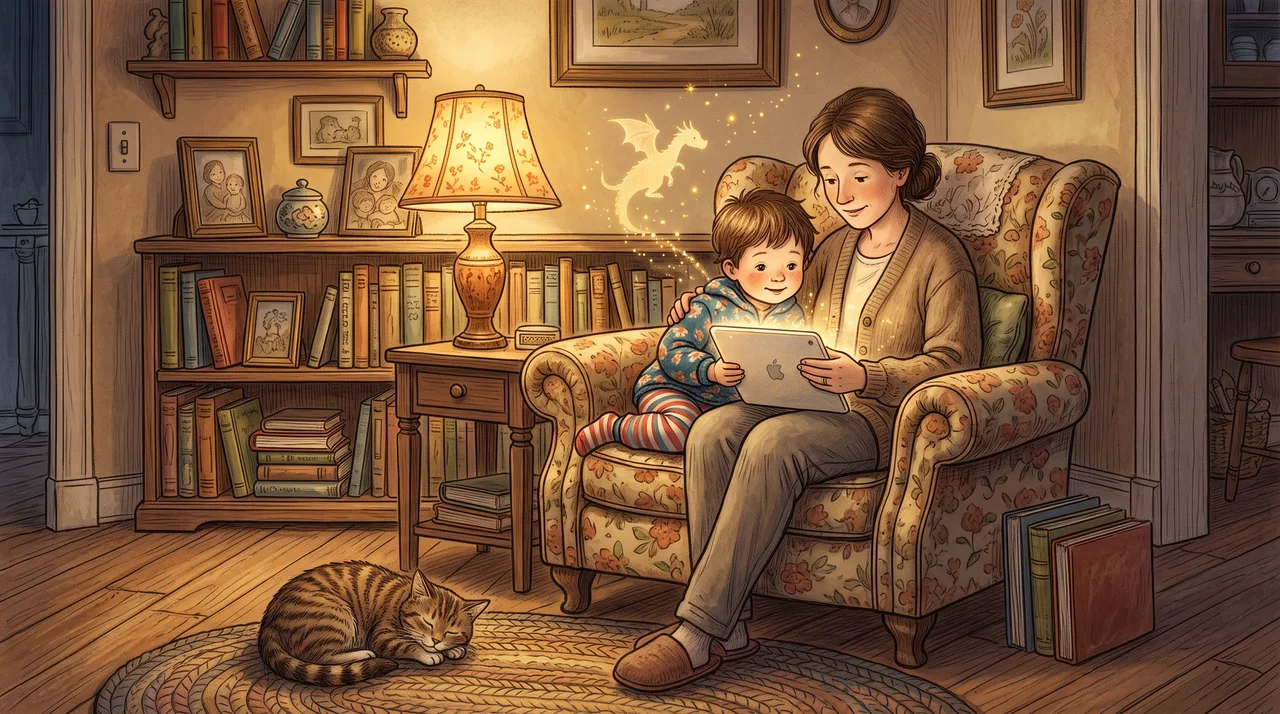
Free, legal fairy tales to read online are mostly classics whose copyright has expired: Project Gutenberg offers thousands of books to download without registration, Wikisource has individual stories you can read straight in the browser, and the Internet Archive children's library opens up old illustrated editions. Newer stories from today's bookshops are practically never legally free online — for those, borrow e-books free of charge through your public library.
Why the classics are free and new bookshop titles are not
In the UK, copyright generally lasts 70 years after the author's death; in the United States the rules depend mainly on when a work was published, and books from around a century ago are now free. The Brothers Grimm and Hans Christian Andersen died in the 19th century, so their tales have been free for well over a hundred years. Beatrix Potter died in December 1943, so in the UK her little books — including The Tale of Peter Rabbit — have been free since 2014. That is why the classics are legally free, while living authors and their publishers understandably keep their rights.
This gives a simple rule of thumb: if the author died more than 70 years ago, the text may be shared freely online. If a site offers a "free download" of a book you can also see on bookshop shelves, it is almost certainly a pirated copy — the text can vanish at any time, and the author, whose next stories might never get written, earns nothing from it.
Which stories suit which age is covered in detail in our article Fairy tales for kids to read: where to get them free and how to choose by age — here we focus on where the texts legally live and how to get them onto your screen.
Three places to read for free, no sign-up needed
- Project Gutenberg (gutenberg.org)The most convenient source: tens of thousands of free e-books in EPUB, Kindle and plain HTML, downloadable in one click without creating an account. You will find Grimm, Andersen, Beatrix Potter and many other classic children's books here. Ideal when you want a whole book on an e-reader or on your phone for a trip.
- Wikisource (en.wikisource.org)Public-domain texts transcribed as ordinary web pages — individual stories read straight in the browser, with no downloads and no ads. Perfect for the "I need one story right now" moment: open, read, close. Every text also has its own link, so you can send tonight's story to Grandma in a single message.
- Internet Archive children's library (archive.org)Scanned historical editions from library collections. Public-domain books can be viewed without logging in — complete with the original illustrations and typesetting, so you and your child leaf through a book as it looked a hundred years ago. More of a shared browsing experience than a text for everyday reading.
Where to start: titles that work well on a screen
- The Brothers GrimmRapunzel, The Elves and the Shoemaker or Hansel and Gretel: short stories with a clear plot, just right for one evening. The language of older translations can feel dated — read them aloud to younger children and explain the old-fashioned words as you go.
- Hans Christian AndersenThe Little Mermaid, The Snow Queen or The Wild Swans: longer, more descriptive tales that suit school-age children used to staying with a longer text.
- Beatrix Potter — The Tale of Peter RabbitThe Tale of Peter Rabbit or The Tale of Squirrel Nutkin: gentle humour and short, vivid stories close to today's children. They are among the youngest classics you can find free and complete online — and a good bridge between the old tales and modern books.
Sources compared: what you'll find where and what you need
| Source | What's there | How you read it | Sign-up |
|---|---|---|---|
| Project Gutenberg | classic fairy tales and children's books | EPUB/Kindle download to phone or e-reader | no |
| Wikisource | individual classic texts | straight in the browser | no |
| Internet Archive | historical editions with illustrations | leafing through scans in the browser | no (for public-domain books) |
| Library e-book lending | modern stories by living authors | EPUB on a time-limited loan | yes — a library card |
| "Free fairy tales" sites requiring an account | often texts shared without the authors' consent | varies, usually between ads | yes — and that is exactly the warning sign |
How to get a story from Project Gutenberg onto a phone or e-reader
- 1Open gutenberg.org and search for an author or title — for example "The Tale of Peter Rabbit" or "Grimms' Fairy Tales".
- 2Pick a format for your result: EPUB for reading on a phone or e-reader, or the HTML version if you want to print a story.
- 3Click to download — Project Gutenberg asks for no account and no e-mail address.
- 4On a phone, open the file in any e-book app; to get it onto an e-reader, use a cable or e-mail it to yourself if your reader supports that.
- 5For the evening, you can print a single story — a copy for your own use is fine, all the more so for public-domain works.
How to spot a site that simply stole the texts
Alongside libraries and archives there are plenty of "free fairy tales" sites that work differently: they only show the text after you register, wrap it in pop-up ads, or openly offer PDFs of current books. Three questions to ask before opening such a site with your child:
Does it want your e-mail or an account for a text that is free? Public-domain works need no registration — you will find the same text on Wikisource without it. The sign-up is not there for you, but to collect addresses.
Does it offer for free a book that is currently on sale? Neither the author nor the publisher allowed that. The giveaway is usually "download the whole book as a PDF" next to titles from current bookshop lists.
Does the site say where the text comes from? Reputable sources name the author and the origin — the edition they transcribed or the licence. A site where the stories "just are" has most likely scraped them from around the internet, including errors and arbitrary edits that are not in the original.
Ad-heavy pages are a chapter of their own: even if the text is legal, reading with a child between banners and pop-ups is not worth it when the same story exists in a clean version on Project Gutenberg.
When online reading works — and when to switch to listening or paper
Reading from a screen is great for parents who read aloud: you have your phone in the waiting room, on the train or on holiday, where there is no bookshelf. For the bedtime routine, though, a glowing screen is less suitable — what to replace it with in the evening and how to build the routine is covered in our article Bedtime stories: texts, audio and a routine that ends in sleep.
When your child does not feel like reading or listening to you, the spoken word helps: CBeebies Radio on BBC Sounds and Storynory offer stories to listen to for free. We write about video and its limits in Read-aloud stories for kids on YouTube: when video is enough and when it isn't.
And if you are looking for a story starring your own child, neither the classics nor the radio can help — Hero of the Book makes a personalised e-book with your child in the leading role: it reads online just like the e-books above, is usually ready within 15 minutes, costs $7.99, and a narrated audio version can be added for $3.99.
Sources
- Copyright, Designs and Patents Act 1988 — section 12, duration of copyright in literary works
- Project Gutenberg — free public-domain e-books to download
- Wikisource — the free library of public-domain texts
- Internet Archive — children's library of digitised books
- BBC Sounds — CBeebies Radio stories to listen to for free