
Baby Clothes Sizes: How to Pick a Gift That Fits
9/26/2026
Why size 50 rarely gets worn, what the number on the label means and which sizes parents run short of. A table by height and season.
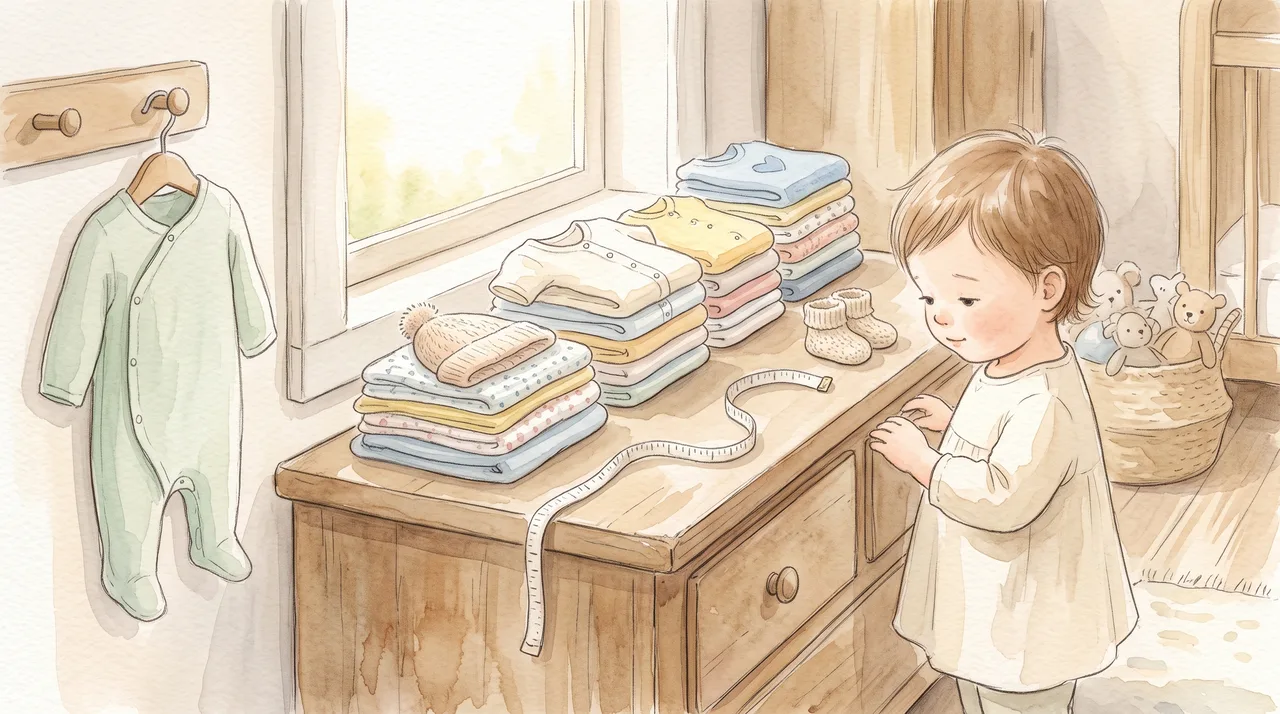
In European sizing, children's clothes are labelled by the child's height (length) in centimetres: size 56 fits a baby up to about 56 cm long. A newborn usually measures around 50 cm, so size 50 is outgrown within a few weeks and often never worn at all. For a gift, buy 68 to 80 and think about the season in which the baby will be wearing that size.
Baby clothes sizes: what the number on the label means
The number on the label isn't an age or a weight, it's the maximum body length the garment is made for. Size 62 therefore fits a baby measuring up to about 62 cm, and covers everything from roughly 57 cm. It comes from the European standard EN 13402, under which children's clothing is sized by body height.
The age that shops print next to the size (say "2–4 months") is just a conversion based on an average baby. According to the WHO growth standards, the average boy measures about 61 cm at three months and around 76 cm at one year, with girls a centimetre or two shorter. Any individual baby can easily be a whole size off the average, in either direction.
Two more practical points: a double label such as 62/68 means the piece will last across both sizes (it tends to be roomier or has a turn-up cuff), and cotton shrinks a little after its first hot wash. Cuts also vary from brand to brand – with some makers, a 68 comes up rather narrow and short.
Size chart: height, approximate age and season
| Size | Baby's length | Approximate age | When it works as a gift |
|---|---|---|---|
| 44 | up to 44 cm | premature baby | only if you know the baby arrived early |
| 50 | 45–50 cm | first days to weeks | almost never – parents have far too much |
| 56 | 51–56 cm | up to about 6–8 weeks | basics only (bodysuits, sleepsuits), not the special outfits |
| 62 | 57–62 cm | about 2–4 months | a safe choice for the birth, but worn only briefly |
| 68 | 63–68 cm | about 4–6 months | a good new-baby gift |
| 74 | 69–74 cm | about 6–9 months | a very good gift, the size most often missing |
| 80 | 75–80 cm | about 9–12 months | a good christening or naming-day gift, and one "for later" |
| 86 | 81–86 cm | about 12–18 months | ideal for a first birthday |
Why newborn-size gifts hardly ever get worn
The adorable little romper in size 50 is the gift most likely to end up in a box with the tag still on. There are four reasons.
Babies are born right at the limit. The average newborn is around 50 cm long, so half of all babies are already bigger than size 50 on day one. And babies grow fastest in the first weeks – according to the WHO curves, they gain about 4 cm a month over the first two months.
Everyone gives it. A new-baby gift tempts people towards the smallest size because it looks the cutest. Parents end up with ten outfits in size 50 and only a few weeks to wear them.
The first weeks are all about comfort. A newborn gets changed several times a day, so at home it's bodysuits, sleepsuits and zip-up all-in-ones that win. Little dresses with buttons down the back or a smart shirt practically never get a turn in the first six weeks.
The season is wrong. A thick size-56 snowsuit for a baby born in April won't get used before winter, because by November the baby will be three sizes bigger.
Size 44 baby clothes: who they're for
Size 44 is designed for premature babies, who are born smaller and lighter. You won't usually find it in ordinary shops, and it doesn't belong in the layette for a full-term baby – even a small newborn will probably fit it for only a few days.
If the baby arrived early, though, it's exactly the gift parents don't have: they weren't expecting the baby so soon, and a standard size 50 is too big. Do ask first what they need – hospitals often have rules about what premature babies can wear, and front fastenings and soft seams matter more than looks.
The sizes parents are actually short of
- 74 and 80The most common gap in the wardrobe. By around six months the baby has long outgrown the gifts from the birth, and nobody brings new ones because the wave of presents has passed. A piece in 74 or 80 is one parents will really use.
- Outdoor clothes for the right seasonA snowsuit, a pram footmuff or softshell trousers in the size the baby will be next winter or spring. Parents have to buy these anyway, and they're expensive.
- Pyjamas and sleeping bags in bigger sizesA baby sleeping bag is bought by the child's length and the season, and gets replaced several times in the first two years. The second and third ones are usually not anyone's gift.
- Good-quality basics, several of eachFive identical bodysuits in 68 will be more welcome than one special-occasion outfit in 56. Basics are in the wash all the time, so you can never have too many.
How to choose a gift size that fits
- 1Find out the birth date or due dateWithout it you're guessing. For a baby who hasn't arrived yet, the month of the due date is enough.
- 2Decide when the gift should be wornA summer dress is no use if summer comes while the baby is still swaddled. Work out how many months old the baby will be in the season you're buying for.
- 3Find the size in the chart and add oneBabies grow unevenly, and a piece one size up can be rolled up, while one size down won't get worn. For a baby born in October who will be eight months old in June, go for 80 rather than 74.
- 4Allow extra room for outerwearA snowsuit or jacket goes on over other layers. Here it pays to go a size up, even beyond what the chart says.
- 5Include a gift receiptMost shops will let you exchange for another size. It saves the parents an awkward moment and a trip with a gift that doesn't fit.
How to ask the parents without spoiling the surprise
Baby essentials: a checklist by size
A rough starter wardrobe for a full-term baby for the first three months. The quantities are a sensible baseline, not a rule – it depends how often you do the washing.
- Size 50–56 (first weeks)4–6 long-sleeved bodysuits, 3–4 sleepsuits or zip-up all-in-ones, 2 thin hats, a few pairs of socks. Nothing more – you'll be given plenty of these anyway.
- Size 62 (up to about four months)The same basics again: 5–7 bodysuits, 4–5 sleepsuits, pyjamas. This is where the wardrobe runs out fastest, because fewer gifts come in 62.
- By seasonIn winter, a snowsuit or footmuff and a knitted hat; in summer, thin short-sleeved bodysuits and a sun hat. Buy in the size the baby will actually spend that season in.
- For sleepingA swaddle or sleeping bag chosen by the baby's length. Sleeping bags are bought by height, not age – it should be longer than the baby, but not so long that the baby could slip down inside it.
When you're not sure about the size
Clothes are the gift most likely to miss, because you're aiming at a number that changes every month. If in doubt, stick to the rule of "two sizes bigger than the baby is now", or pick a gift that doesn't depend on size at all. For ideas on sharing out new-baby gifts with others, see New-baby gifts: three piles and what goes where, and for christenings, Christening gifts: who gives what and how to avoid doubling up.
If you'd like to give something the baby won't outgrow in a month, it could also be a personalised book in which the child, based on a photo, is the hero. For a newborn it's more of a gift for later – it makes sense once they can listen to a story, for example for a first birthday.
Sources
- WHO Child Growth Standards — Length/height-for-age — Growth charts for children's length from birth to five years (medians by sex and month).
- WHO Child Growth Standards — Weight-for-age — Growth charts for children's weight from birth.
- EN 13402 — Size designation of clothes — The European standard for clothing size labels; for children, sizes are based on body height.