
Visiting after a birth: when, how long, what to bring
10/8/2026
A visit after the birth should take work off the new mum, not add to it. When to get in touch, how long to stay, what to bring and how home visits work.
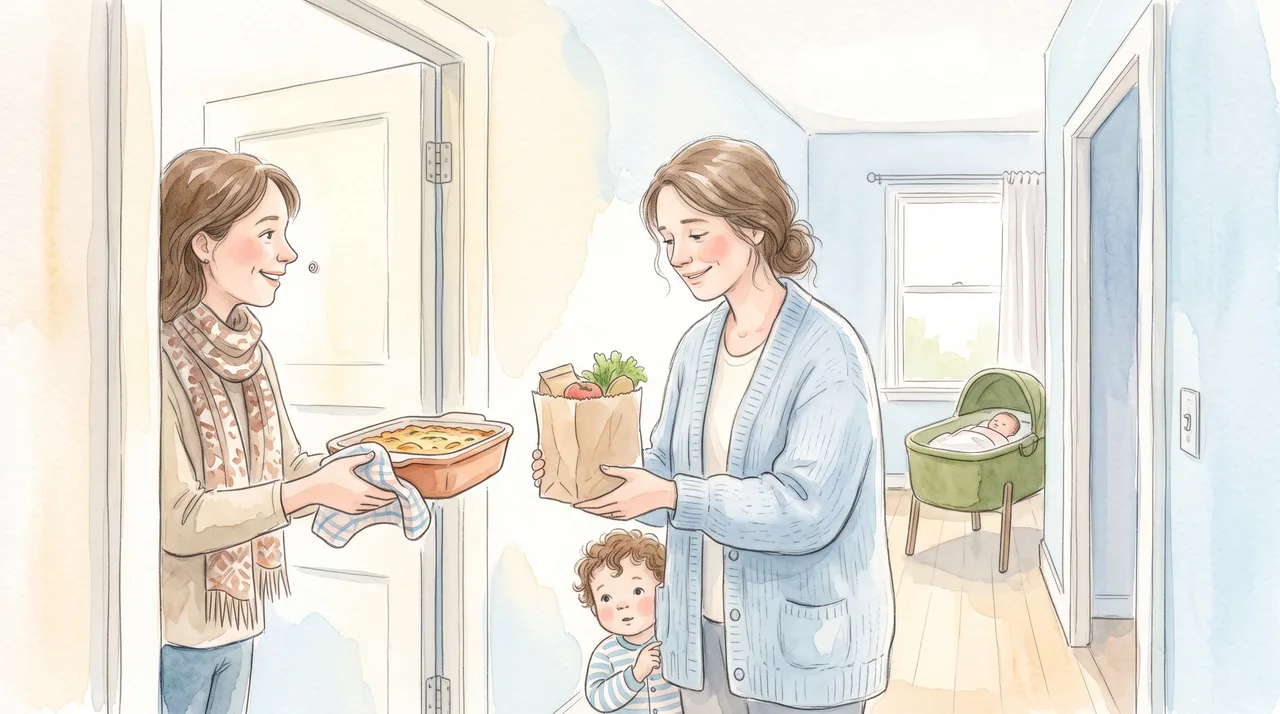
Visit after the birth once the parents invite you – for friends and more distant family, that's more likely two to four weeks later than right after they get home from hospital. Stay about an hour, bring food or offer specific help, and don't come at all if you have a cold. Health visits (midwife, nurse, doctor) are a different matter and take priority in the first days.
When people visit after a birth
In the first days at home, the family is still learning to feed, to sleep in snatches and to recover from the birth. On top of that come the baby's first medical check-ups, and a midwife or nurse may call in as well.
A social visit doesn't belong in the middle of that. A sensible order is usually: closest family first (grandparents, the parents' siblings), who tend to come to help rather than to look; then friends; and finally colleagues and acquaintances. The rule that always works: the parents pick the time, not you. Asking “when would suit you?” gets a more honest answer than “can I come tomorrow?”, which is hard to say no to.
Be ready for an agreed visit to be cancelled that morning. A night with a newborn can't be planned. If the parents cry off, don't take it personally – suggest another day, with no reproach.
Who, when and for how long
| Who | When to get in touch | How long | What to bring |
|---|---|---|---|
| Grandparents and closest family | as agreed, even in the first week | as long as they're helping – cooking, tidying, older siblings | food, shopping, looking after the older child |
| Close friends | after the first week, once the parents get in touch | 30–60 minutes | a ready-made meal, a little something for mum |
| Colleagues and acquaintances | after three to six weeks or later | up to an hour | a small gift, ideally one joint gift from the group |
| Friends with young children | not until after the first six weeks, unless the parents say otherwise | briefly | without children, or only healthy ones |
A visit step by step, so it isn't a burden
- 1Text, don't callA message can be read at three in the morning during a feed; a phone call wakes the baby. Offer two or three times and make it clear that “not now” is completely fine.
- 2Confirm the day beforeA quick “still OK for ten tomorrow?” gives the parents room to put the visit off without any awkwardness.
- 3Check your own healthA runny nose, cough, fever, stomach bug or a sick child at home means moving the visit. A newborn copes with infection worse than an adult does and hasn't had a single vaccination yet.
- 4Arrive on time and smoke-freeMum and baby are often sensitive to smoky clothes and strong perfume. Take your shoes off and wash your hands as soon as you arrive, even if nobody asks you to.
- 5Don't pick up the baby uninvitedWait until the parents offer the baby to you. Don't kiss the baby's face or hands, and don't wake a sleeping baby – a photo isn't worth it.
- 6Do one extra thingEmpty the dishwasher, hang out the washing, take out the bin, make a cup of tea. Don't ask “can I help with anything?” – say what you're going to do.
- 7Leave before they see you outAn hour is plenty. When mum starts drifting off to feed or yawning, that's a signal, not a polite pause.
What to bring to a visit after a birth
- Ready-made food in containers they don't have to returnSoup, stew, lasagne or a pasta bake for two days. Write on the lid what it is and how to reheat it. If mum is breastfeeding and avoiding anything, ask beforehand – there's no point guessing.
- A snack that can be eaten with one handCut fruit, nuts, cheese, homemade granola bars. The other hand is often busy feeding the baby.
- Shopping from a listAsk what's running low: bread, milk, nappies, maternity pads. It's the least romantic and most appreciated gift of all.
- A little something for the older siblingThe older child notices that everyone brings presents for the baby. A small gift just for them – a colouring book, a storybook, a toy car – shows them nobody has forgotten them.
- What not to bringCut flowers (the parents then have to deal with the vase, the water and the wilting leaves), big toys, clothes in the smallest size that the baby will grow out of in a few weeks, and anything strongly scented.
A gift that genuinely helps mum
The best gift after a birth is time and food – a physical present comes second. If you want to bring something tangible, think of mum rather than the baby: after the first few weeks, parents often have more baby kit than they can use. Ideas based on what is really missing in those first weeks are in the article A gift for mum after the birth, and if you're clubbing together with colleagues, a gift basket for mum after the birth full of things to use up works well.
If you'd like to give the baby something too, it helps to work out who the new-baby gift is really for. For an older sibling, a gift where they themselves are the main character works well: for example a personalised book in which they are the hero and the new baby brother or sister plays only a supporting role – better suited to a later visit than to the first week.
Midwife and nurse home visits after the birth
Alongside social visits there are health visits. A midwife or nurse may come to the home after discharge from hospital and, in the first weeks, check how any tears or a caesarean scar are healing, how the womb is contracting, how feeding is going, whether the baby is gaining weight, how the umbilical stump is healing and whether the baby is turning yellow.
Which home visits are offered, who carries them out and on what terms depends on how postnatal care is organised where the family lives. The most reliable answer comes from the hospital, the midwife or the family's doctor – it's worth asking during pregnancy.
The newborn's medical check-ups are a separate matter. The hospital or the family doctor or paediatrician will say when and where they take place – it's a good idea to sort out who will look after the baby before the birth.