
Speech Development Toys: Let Your Child Do the Talking
10/14/2026
A talking toy talks for your child. Pick toys where your child has to speak: a guide by age, phrases that get them talking, and when a toy isn't enough.
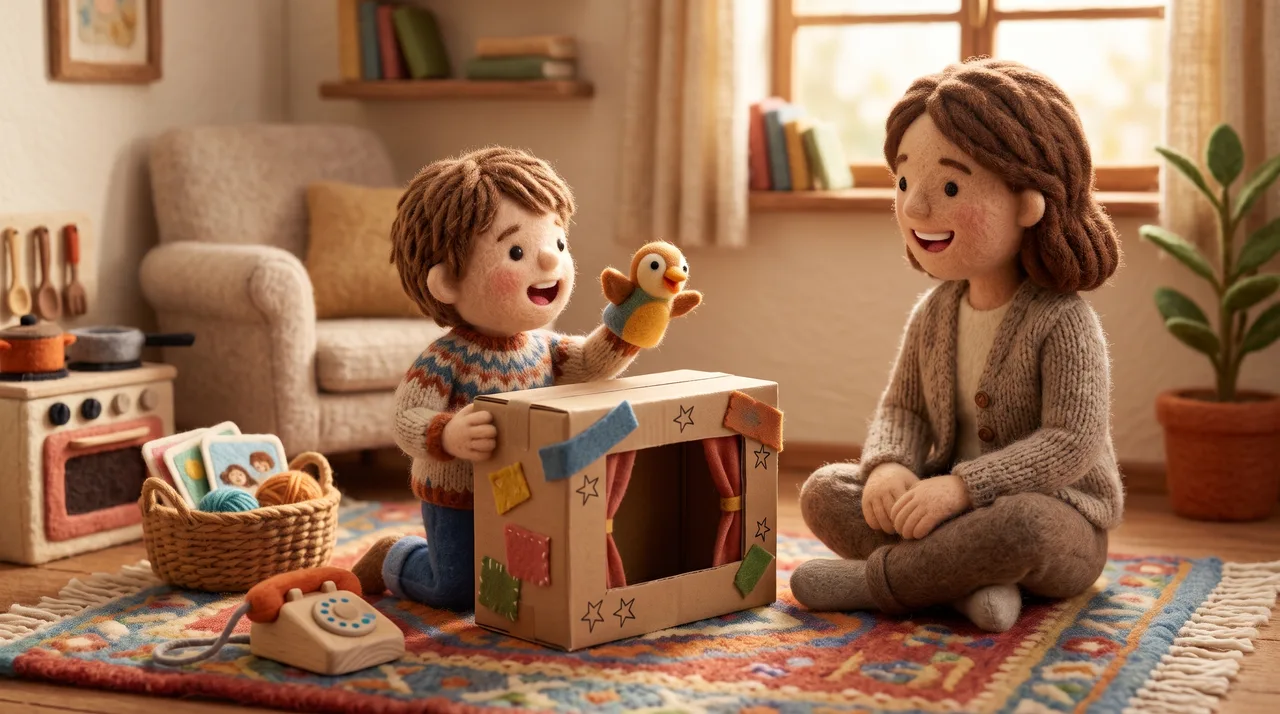
The toys that do the most for speech are the ones that say nothing on their own: a puppet, a toy phone, a play kitchen, animal figures, picture cards or a book without buttons. With these, the child has to do the talking, along with the adult playing alongside. A toy that sings, counts and names things for the child takes away their reason to speak up.
Why talking toys tend to hold speech back
Children don't learn to talk by listening to a speaker. They learn through turn-taking: the child says something, the adult answers, the child responds. Every one of those exchanges is a tiny lesson. A toy with buttons short-circuits it. The child presses, the toy talks, done. Nothing needs to be said, so nothing is.
A study by U.S. researchers published in JAMA Pediatrics (2016) showed this clearly. Parents played at home with their 10- to 16-month-olds, taking turns with electronic toys, traditional toys and books. With the electronic toys, parents talked less, responded less to what their child was doing, and the children themselves vocalized less. Books produced the most words, with traditional toys close behind.
That doesn't mean the flashing gadget is off-limits. Just don't count it as a speech toy: it keeps a child busy, but it won't teach them new words.
Toys where the child has to do the talking
- A hand puppet or finger puppetsA puppet gives a child a second voice. A shy child who won't answer you will often speak up "for the puppy." One or two puppets and a cardboard box for a stage are all it takes.
- A toy phoneYou can't make a phone call in silence. A plain phone with no sounds beats one that rings and talks by itself, because the child has to act out the call.
- Play kitchen, store, doctor kitPretend play calls for whole sentences: "What would you like?", "How much is it?", "Where does it hurt?" Children try on other people's roles, and with them words they rarely hear at home.
- Animals and a farm setFor the youngest, first sounds (moo, meow, quack); for older kids, whole stories: who ran away from whom, who's hungry, who got lost.
- Picture cards and MemoryTurning over a card means naming it, and for older kids, describing it: "It's an animal, it has a long neck and it eats leaves." Guessing games with cards build vocabulary and sentence structure.
- Blocks and figuresBuilding blocks aren't about language on their own, but the moment a figure moves into the house, the storytelling starts. Add a car or an animal and ask where it's going.
- Books without buttonsA picture book is the most powerful speech toy there is, as long as you talk about it instead of only reading it aloud. Point, name things, and let the child finish a line they know by heart.
What to choose by age
| Age | What the child is doing with language | Toy | How to play |
|---|---|---|---|
| 1–2 years | first words, pointing, imitating sounds | animal figures, a ball, a board book, a box with a lid | name what the child points at; make animal sounds and wait for them to copy you |
| 2–3 years | puts two, then three words together, asks "what's that?" | phone, play kitchen, cars with a garage, picture cards | stretch their sentences by one word: "car" → "blue car goes" |
| 3–4 years | short sentences, "why?" questions, first stories | puppets, a pretend store, doctor kit, Memory | play a role where they have to ask and answer, then switch roles |
| 4–6 years | tells what happened, rhymes, guesses | figures for stories, riddle cards, picture blocks | let them make up what happens next; play guess-the-object from a description |
Phrases that get a child talking
How to play so the child talks, not you
- 1Get down to their levelSit on the floor, face to face. Children also learn speech by watching the mouth of the person talking.
- 2Follow their leadPlay with what they picked. A child talks about whatever has their attention right now, not about the thing you slide in front of them.
- 3Comment, don't quizNarrate what's happening ("The car is going up the hill... and crash!") instead of firing off questions you already know the answers to.
- 4WaitAfter you say something, count to five in your head. Silence is an invitation. Most adults fill it themselves before the child has even taken a breath.
- 5Add one more wordAnswer one word with two, and two words with a short sentence. Always just one step ahead of what the child can already do.
- 6Keep it short and frequentTen minutes of focused play a day does more than an hour side by side with everyone looking somewhere else.
A book as a toy for talking
In that study, books came out on top because a picture explains nothing by itself. The adult and the child have to do it. But that only holds for a book you talk about. Sound books with buttons are really a talking toy in a paper jacket: fine for fun, not for language development. For more on books you can play with, see the article on interactive books.
A book in which the child recognizes themselves is also great at getting them talking. When they're the hero of the story, they want to retell it to Grandma, fill in what happened next and add their own ideas. A personalized book can do exactly that: one photo becomes a hero who looks like your child, the story has 12 illustrated spreads, and it's usually ready within 15 minutes. You can stop at every spread and ask: "What do you think they'll do now?"
What not to buy, and when a toy isn't enough
Toys that talk for the child aren't worth it for speech: the interactive puppy that recites the alphabet on its own, a tablet with "educational" games, or a sound-button board. Also watch out for small parts on puppets and figures for children under three. For ideas based on skills rather than age, check out our gifts for preschoolers.
No toy can replace a professional, though. Pay attention if your child isn't talking at all or isn't putting two words together around their second birthday, if even people who know them well can't understand them around age three, or if they're losing speech they already had. Then talk to your pediatrician and a speech-language pathologist. Getting checked early always beats waiting to see if they'll "grow out of it."
Sources
- Sosa A. V.: Association of the Type of Toy Used During Play With the Quantity and Quality of Parent-Infant Communication — JAMA Pediatrics, 2016: a comparison of electronic toys, traditional toys and books.
- Yogman M. et al.: The Power of Play — Pediatrics, 2018: a clinical report from the American Academy of Pediatrics on the importance of play.
- ASHA: How Does Your Child Hear and Talk? — An overview of what children typically do with speech and language at each age.